Oxalis bicolumnar
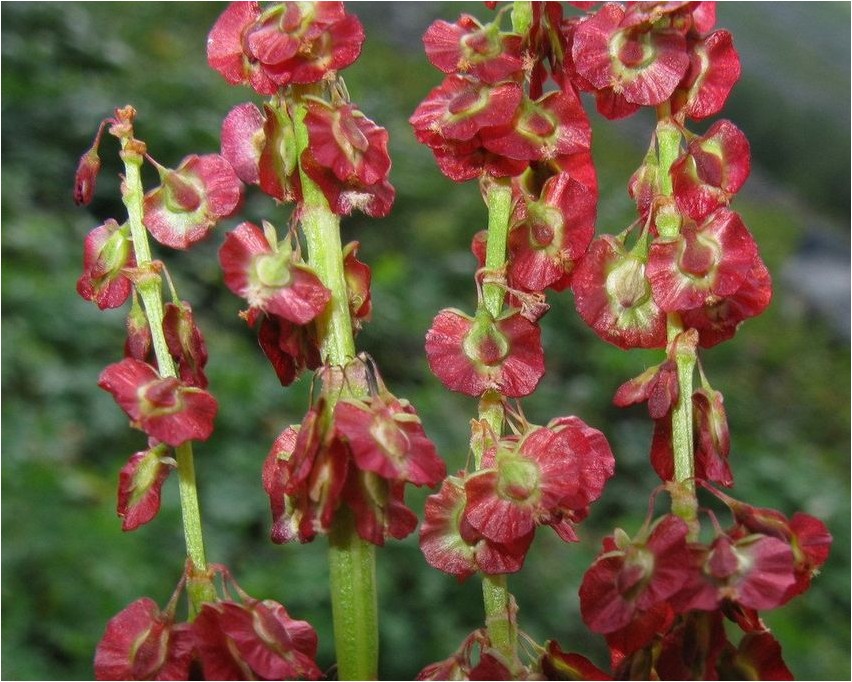
Oxorale bicolumnarum is one of the plants of the family called Buckwheat; in Latin the name of this plant will be as follows: Oxyria digina (L.) Hill.
As for the name of the two-columnar sorrel family itself, in Latin it will be: Polygonaceae Juss.
Description of the bicolumnar sorrel
The bicolumnar sorrel is a perennial herbaceous plant, the height of which will reach ninety centimeters. The rhizome of this plant will be quite thick, its thickness will be about half a centimeter to one centimeter. The stems can be either several or single. Such stems are bare, erect or straight, and in inflorescences such stems will be branched. All leaves are basal, rarely they are one or two on the stem, such leaves are long-petiolate, they can be either rounded-reniform or kidney-shaped. In diameter, the length of such leaves will be about two to four centimeters. The flowers of the bicolumnar sorrel are painted in white tones; they can be pink with dark anthers. Such flowers are bisexual, they are on rather thin pedicels that articulate at the bottom. Such flowers are collected in groups of two to six at the ends of branches and stems, forming a racemose narrow inflorescence. The fruit of this plant is a capsule that will crack when ripe and scatter its seeds quite far.
The flowering of sorrel oxalis occurs during the period from June to July. Under natural conditions, this plant is found in the Arctic, in the Far East, in the alpine region of the Caucasus, in the mountainous regions of Central Asia, as well as in Western and Eastern Siberia. For growth, this plant prefers damp rocks and pebbles, the alpine belt in the mountains and the Arctic region, as well as in the tundra along the banks of streams.
Description of the medicinal properties of sorrel sorrel
The bicolumnar sorrel is endowed with quite valuable healing properties, and it is recommended to use the grass and leaves of this plant for medicinal purposes. The presence of such valuable healing properties should be explained by the content of catechins, carotene, leukoanthocyanidins, vitamin C and K in the plant.
The aerial part of the bicolumnar sorrel contains flavonoids, phenol carbonic acids, caffeic and chlorogenic, as well as carotene, the maximum content of which is observed during the flowering of this plant. The leaves of this plant contain carotene, tannins, oxalic and citric organic acids, vitamins C, K and PP, anthraquinones and flavonoids. The inflorescences of this plant contain flavonoids, tannins and anthraquinones, while the fruits contain carotene and the following vitamins: C, K and PP.

The herb of this plant is recommended to be used as an antiscorbutic and antipyretic agent, and the leaves of the bicolumnar sorrel are used as an astringent and antidiarrheal agent.
It should be noted that bicolumnar sorrel leaves can be used in food in the form of salads as a very valuable source of vitamins A and C.
As an antiscorbutic and antipyretic agent, you should use the following remedy based on sorrel bicolumnarum: to prepare such a remedy, you will need to take one tablespoon of crushed herbs of this plant per glass of boiling water. The resulting mixture should be infused for one hour, and then this mixture is filtered very carefully. Take the resulting product based on sorrel sorrel, two tablespoons three times a day.





