Gorse
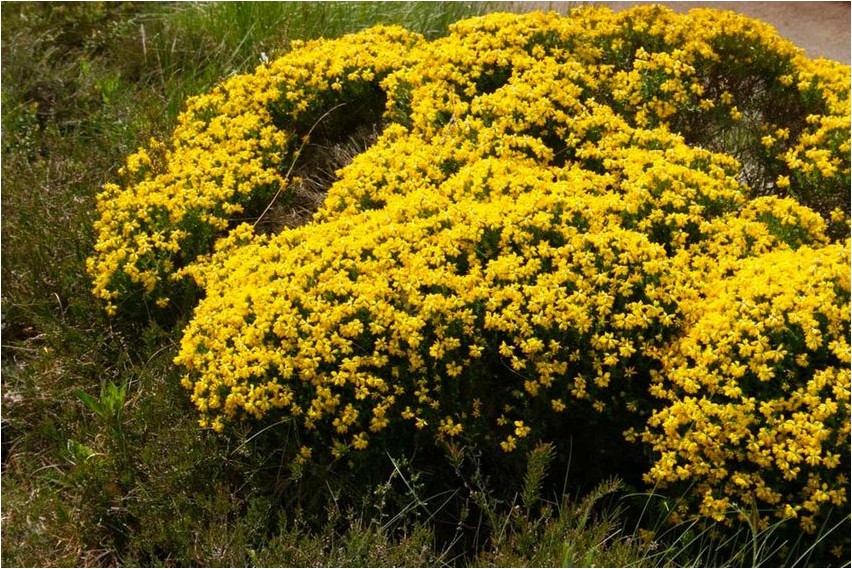
Gorse (lat. Genista) is a genus of subshrubs, shrubs and vines of the Legume family. The genus has about 100 species. In nature, the plants are found in the Mediterranean, North America, Europe, Asia and the Middle East.
Common types and their characteristics
*English gorse (lat. Genista anglica) — the species is represented by shrubs 0. 5-0. 8 m high. The leaves are trifoliate, densely pubescent. The flowers are whitish or yellow, collected in racemes. Growing season: from April to mid-October. English gorse blooms in May-June, flowering lasts about three weeks. Plants begin to bear fruit in the third year after planting. Typical places of growth in nature are peat heaths.
*German gorse (lat. Genista germanica) — the species is represented by shrubs up to 120 cm high. The branches are straight and pubescent. The leaves are sessile, lanceolate, up to 2 cm long, the edges are ciliated and pubescent, and equipped with green spines at the base. The flowers are golden-yellow, collected in racemes, located at the ends of almost every shoot. German gorse blooms in June-July, flowering lasts 3-5 weeks. The fruits ripen in the first or second decade of October. Fruit ripening occurs simultaneously with shoot growth. The seeds of the species in question almost do not sprout; green cuttings are used as planting material. In nature, the plant is found in forests (pine and birch forests) of the European part of Russia and in many European countries. German gorse cannot boast of cold-resistant properties and needs shelter for the winter.
*Lydian gorse (lat. Genista lydia) — the species is represented by creeping evergreen shrubs. Very decorative, great for rock gardens and dry rocky walls. Lydian gorse blooms from April to June. Tolerates frosts down t o-15C and requires shelter for the winter. Typical places of growth in nature are calcareous and rocky hills. It is grown in large quantities in Bulgaria, Turkey and Syria.
*Radiated gorse (lat. Genista radiata) — the species is represented by a straight shrub 40-80 cm high. The shoots are numerous, ribbed, and have no thorns. The leaves are trifoliate, dark green, and consist of oblong leaflets. The flowers are yellow, collected in short racemes, formed at the ends of the shoots. Gorse radiata blooms in May-June. The fruit is an oval-pointed bean up to 1-1. 2 cm long, containing 1-2 seeds. The seeds are dark brown with shine and ripen in September-October. The species in question is propagated by seeds and cuttings. Under natural conditions, radiata gorse is found on clay-rocky hills. Looks harmonious in borders and single plantings, as well as in rocky gardens.
*Spanish gorse (lat. Genista hispanica) — the species is represented by evergreen shrubs with numerous straight stems, prickly at the base. The leaves are bright green, rounded, trifoliate. The flowers are bright yellow, fragrant, and appear on the leafless tips of the stems. The fruit is a flat multi-seeded pod. Spain and France are considered to be the homeland of the species; Spanish gorse has also spread to the Crimea, where it is gradually going wild. Plants bloom in the second or third year after planting. Flowering is long lasting and may bloom again closer to autumn. The species is not winter-hardy, withstands frosts down t o-10C.

Growing conditions
Gorse is light-loving and drought-resistant, grows well in intensely lit areas, some species are able to develop normally in partial shade. The soils for growing the crop are preferably rocky, limestone and dry sandy loam. Gorse does not accept waterlogged, swampy and highly acidic soils. Gorse is relatively frost-resistant, but in cold winters the shoots freeze to the surface of the soil.
Reproduction and transplantation
Sowing of gorse seeds is carried out in autumn or spring. Seeds do not need preliminary stratification. Shoots appear unevenly; after sowing, about 2-2. 5 months pass. Before emergence, it is important to regularly water and remove weeds.
Cuttings are a more effective way to propagate gorse. Cuttings are cut in June. The cuttings are planted in a greenhouse. Before planting, cuttings must be treated with growth stimulants. It is better to transplant gorse in early spring or August.
Care
Care consists of standard procedures for all ornamental shrubs, or rather, weeding, loosening the soil in the tree trunk area, rare watering and sanitary pruning. Most types of gorse do not need forming trimmings, since they have fairly compact shapes. Too old specimens are subjected to anti-aging pruning. All work with gorse should be carried out with gloves, as the plants contain toxic substances (sideteine, anagyrine, sparteine, cytisine and methylcytisine).





