Rambai
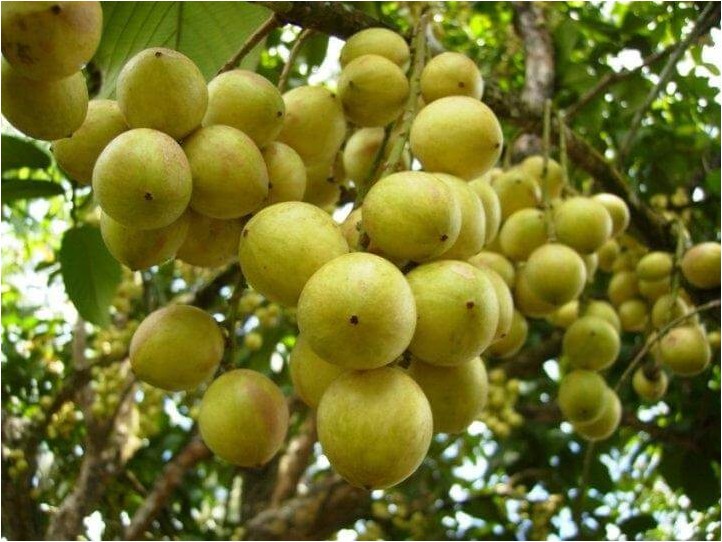
Rambai (lat. Baccaurea motleyana) is a fruit tree belonging to the Euphorbiaceae family, scientifically called Baccorea Motley. This crop is also called rambi.
Description
Rambai is a dioecious, slow-growing evergreen tree that grows from nine to twelve meters in height. Each tree is endowed with a fairly dense and wide crown, and the diameter of its trunks can reach sixty centimeters.
Glossy dark green leaves of rambai sit on short petioles. The average length of the leaves is from fifteen to thirty-three centimeters, and the width is from seven and a half to fifteen centimeters. The shape of the leaf blades can be either lanceolate or ovoid. The edges of the leaves are entire, and the tips are blunt.
The greenish-yellowish flowers of rambaya, endowed with four to five sepals, are devoid of petals and are collected in attractive racemes.
The length of the oval fruits collected in clusters ranges from two and a half to four and a half centimeters. Each fruit is endowed with an orange-pinkish or brownish-yellowish skin that wrinkles when ripe. And inside the fruit there is segmented translucent whitish pulp, in the middle of which you can find from three to five flat and long brown seeds. As for the taste of the fruit, it is sweetish-sour.
Where does it grow
The Malay Peninsula is considered the birthplace of rambai. This plant can be found both in the wild and in cultivation — rambai is especially often seen in Kalimantan, Java and a number of other Indonesian islands. It also grows in Cambodia, Thailand and Southern China.

The export of rambaya fruits outside of Southeast Asia is largely hampered by the fact that these fruits are extremely poorly stored. But in local markets (in those countries where rambai is cultivated) you can taste them at any time.
Application
Rambai fruits are not only eaten raw — they are canned, stewed, and all kinds of alcoholic drinks and juices are also made from them.
The abundance of microelements and vitamins in rambai makes these fruits an excellent general tonic. If eaten regularly, it will significantly increase the body”s resistance to various diseases. In addition, miraculous fruits have a beneficial effect on the nervous and cardiovascular systems, as well as the gastrointestinal tract. And the large amount of antioxidants in rambai helps to significantly improve the condition of the skin.
Rambaya bark also has healing properties — drugs that reduce eye inflammation are made from it.
Unfortunately, at the moment, detailed information about the full chemical composition of the fruits and other parts of rambai is not available, since this fruit has not yet been sufficiently studied.
Rambai is also often grown to create dense shade.
Contraindications
There are no contraindications to the use of rambai as such, but sometimes individual intolerance may occur.