Prince of Siberia
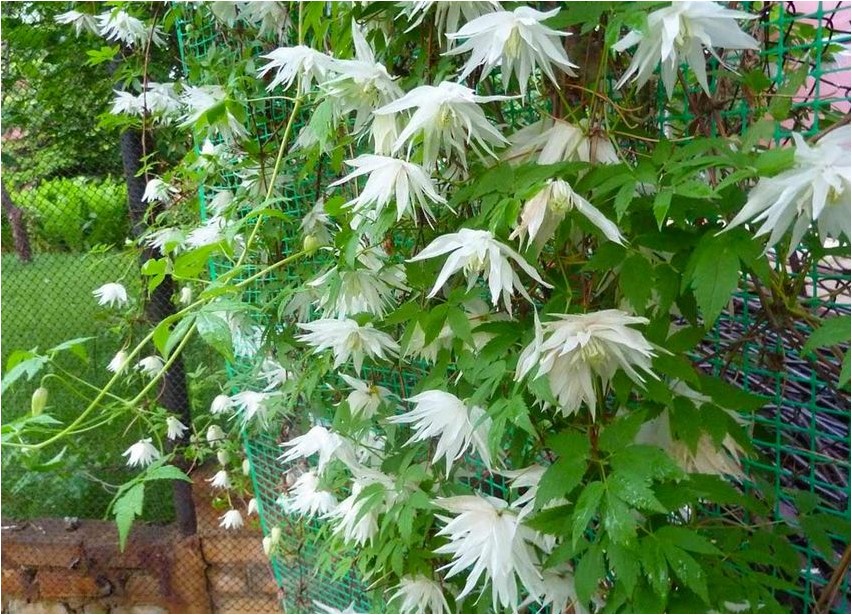
Prince Siberian is one of the plants of the family called Ranunculaceae; in Latin the name of this plant will be as follows: Atragene sibirica L.
As for the name of the Siberian Prince family itself, in Latin it will be: Ranunculaceae Juss.
Description of the Siberian prince
Prince Siberian is a subshrub, the length of which will be about half to three meters. The stems of this plant are recumbent or can be clinging. The leaves of Prince Siberian are endowed with petioles; usually such leaves are double-triple. The lobes of this plant will be serrated, pointed and lanceolate, underneath they are paler, and along the veins they will be pubescent. Prince Siberian flowers will be single. The sepals are ovate-lanceolate in shape, they are painted almost white or yellowish-white. It is noteworthy that the petals are approximately two to three times shorter than the sepals themselves. The fruits are compressed and heavily pubescent.
Flowering of the Siberian princeling occurs during the period from June to July. Under natural conditions, this plant is found in Central Asia, in the north of the European part of Russia, in Western and Eastern Siberia. For growth, the plant prefers forest edges, forest meadows, coastal thickets, rocky outcrops, mountainous areas on rocky slopes, coniferous and deciduous forests, and this plant will also climb beyond the forest belt.
Description of the medicinal properties of the Siberian prince
Prince Siberian is endowed with very valuable healing properties, and it is recommended to use the herb of this plant for medicinal purposes. The concept of grass includes the flowers, leaves and stems of Prince Siberian.
It should be noted that the grass of this plant is poisonous, for this reason it is recommended to exercise extreme caution when handling Siberian princeling. It is noteworthy that preparations based on the herb of this plant have the ability to stimulate cardiac activity; the strength of such an effect can be comparable to caffeine.

The presence of such valuable healing properties should be explained by the content of Siberian princely polysaccharides, protoanemonin, saponins, sugar, cardiac glycosides, vitamin C, flavonoids glkiosides kaempferol and quercetin, caffeic and quinic acid. This plant also contains the following trace elements: magnesium, aluminum, iron, manganese, nickel, cobalt and silicon. It should be noted that this plant produces quite a large amount of phytoncides.
As for traditional medicine, here this plant is used for various tumors, influenza, pulmonary tuberculosis, cardiac weakness, dizziness, headache, malaria, diarrhea, colds, retained placenta, epilepsy, and also for metabolic disorders. In addition, Siberian princeling is also used as a general tonic and as a vision-improving agent. As for external use, it is recommended for scabies, rheumatism and paralysis.
It should be noted that the healing properties of the Siberian prince were also highly valued in Mongolian and Tibetan medicine. In this case, the plant was used for numerous diseases: cancerous tumors, women’s diseases, dropsy, liver diseases, edema, ascites, lung diseases and abscesses. Also, such products were also used as wound healing and cardiac. It is noteworthy that this plant is also one of the most powerful insecticides. An aqueous infusion of Siberian princeling turns out to be destructive for lice, bedbugs, ants and other insects.





