Garlic
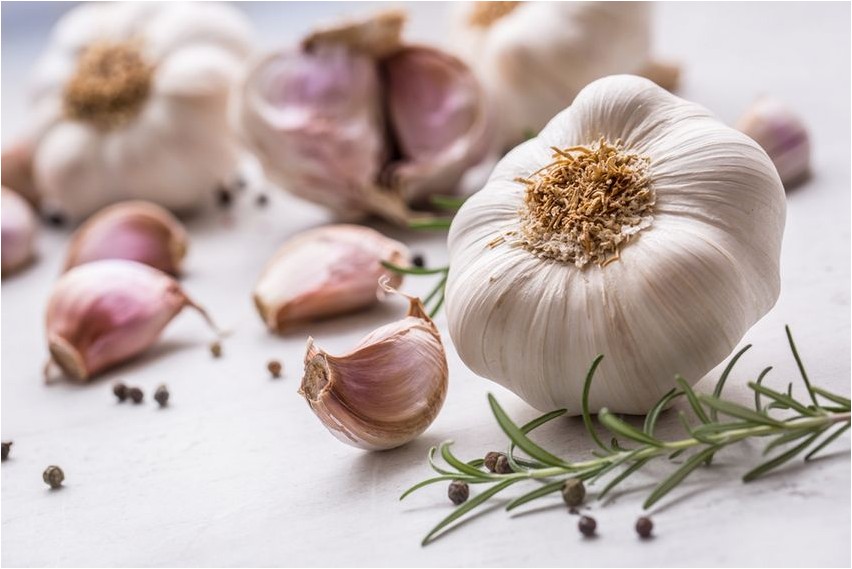
Garlic (Allium sativium) is a popular vegetable crop belonging to the Allium family.
Description
Garlic is represented by a plant consisting of narrow linear thin leaves and a complex bulb divided into cloves. The bulb is round in shape, slightly flattened, forms up to fifteen cloves in the axils, which fit tightly to each other and are covered with hard scales. The bulb can be white, yellowish, pink-violet or dark purple in color. The teeth are oblong, with a convex surface, slightly thickened towards the middle.
The leaves are narrow, smooth, elongated, pointed at the end, drooping or erect, 30-100 cm long, with a keel 1 cm wide on the underside. Each leaf grows from within the previous one, resulting in a complex, strong stem. The flowering stem (peduncle, arrow) is up to 150 cm high and twists into a spiral before flowering. The inflorescence is a spherical umbrella consisting of flowers (bulbs) on long stalks, their number, shape and color depending on the variety.
Cultivation conditions
Garlic is a frost-resistant crop that can easily endure cold winters with air temperatures dropping t o-30C. The crop does not make any special demands on the sun, it is resistant to spring frosts, the normal temperature for growing the plant is 15-25C. Garlic is not picky about soil conditions, but its predecessors can only be annual crops — cucumbers, cabbage, potatoes.
Cultivation of winter garlic
Winter garlic is planted in October, but before the onset of cold weather. Later planting dates are dangerous for the crop because the cloves do not have time to take root and as a result die. The site for the variety in question should be warm and protected from cold winds. Two weeks before planting the clove, the soil is dug up and organic matter and mineral fertilizers are added to it.

The crop is planted in cloves, which are pre-treated in a weak solution of potassium permanganate for the purpose of disinfection. Garlic is planted in a row with row spacing of 20-30 cm and 5-7 cm between cloves. The depth of embedding should be 7-10 cm. Mulch is applied to the ridges with plantings; in winter they will be insulated with snow cover.
With the onset of spring, they are fed with potassium salt or superphosphate, and they are also sprayed with slurry. Before forming the bulbs, wood ash is added to the soil.
Care and harvesting of winter garlic
Garlic is a moisture-loving crop; it has a negative attitude towards drought and heat, for this reason it requires daily watering. Weeding is carried out as needed, but keeping the beds clean is very important. Loosening is carried out once every three weeks, but very carefully, trying not to damage the developing bulb. In order to increase the yield of winter garlic, the shoots formed during the growth of the crop are removed.
Harvesting begins as soon as the leaves turn yellow and fall. The garlic is pulled out of the soil, cleaned of the soil and dried in the open sun, after which the stem is cut a couple of centimeters above the bulb itself. It is recommended to store winter garlic in boxes or drawers at home. Better in a dark, ventilated closet.
Subtleties of cultivating spring garlic
Planting of spring garlic begins in early spring, immediately after the snow cover has completely melted. The beds for plant cultivation are prepared in the fall: the soil is dug up, organic and mineral fertilizers (nitrogen, phosphorus and potassium) are applied. Before planting the cloves in the ground, they are first germinated by wrapping them in dampened cloth or gauze. After the appearance of roots 1. 5 cm long, the teeth are planted in the soil in rows with a row spacing of 20-30 cm. Planting depth is 3-5 cm.
Care and harvesting of spring garlic
As soon as the first shoots appear on the ridges, nitrogen fertilizers are applied to the soil. It is also important to regularly water, weed and loosen. The ridges are loosened a couple of times a month. As soon as the leaves turn yellow, begin harvesting. The crop is pulled out of the ground, shaken off, dried and trimmed. You can store spring garlic in boxes at room conditions.