Maned Caragana
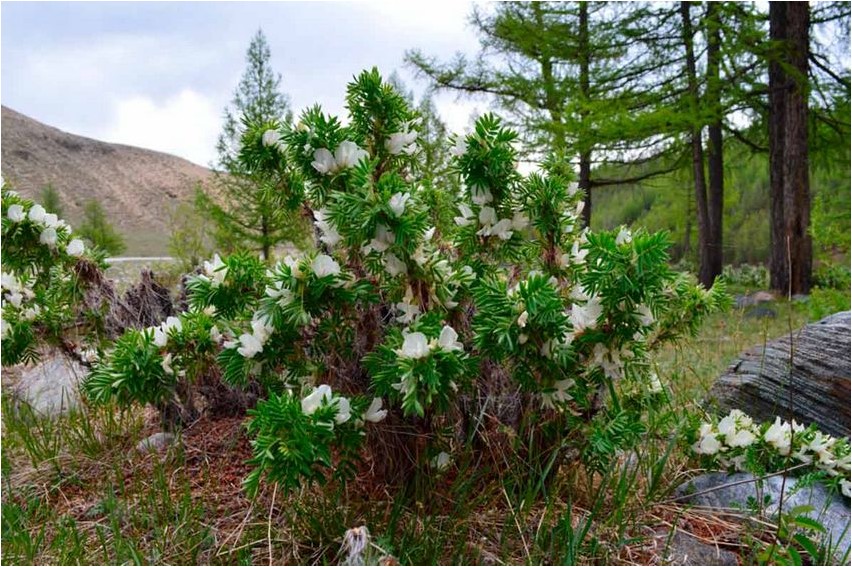
Caragana jubata is one of the plants of the family called legumes; in Latin the name of this plant will be as follows: Caragana jubata (Pall.) Poir.
As for the name of the caragana family itself, in Latin it will be like this: Fabaceae Lindl.
Description of caragana maned
Caragana mane is a shrub whose height will vary between one and five meters. The branches of this plant are quite long, they are saber-shaped and have little branching. Such branches are covered with gray or blackish bark, they are densely leafy and are covered with petioles of leaves from previous years. The leaves of this plant are shaggy along the edges, and they will be colored in dark green tones. The stipules of Caragana mane are large and they are endowed with thick white pubescence. The flowers of this plant are single, they are colored pink, and sometimes they can also be white. The length of such flowers will be about twenty-seven to thirty-two millimeters. The fruits of Caragana mane are a hairy bean that will end in a hard awl-shaped point.
This plant blooms from June to July, while fruiting begins in August-September. Under natural conditions, the maned caragana is found in Eastern Siberia, Central Asia, the European part of Russia in the Siberian Arctic, and also in the Okhotsk region in the Far East. For growth, the plant prefers clay slopes, dry rocky slopes, rocky and sandy shores of lakes, floodplains, high-mountain steppes, hills, coniferous forests, alpine forests and places among bushes.
Description of the medicinal properties of caragana mane
Caragana mane is endowed with very valuable healing properties, and it is recommended to use the wood, branches and roots of this plant for medicinal purposes. The presence of such valuable healing properties is explained by the content of saponins, essential oil, tannins, alkaloids and flavonoids in the plant. The roots of this plant contain saponins, and flavonoids are present in the aerial parts of caragana mane. The branches and leaves of this plant will contain tannins.
A decoction of the roots and branches of caragana mane should be taken for acute respiratory diseases and influenza. A decoction and infusion of the branches of this plant should be used for laryngitis, stomatitis, inflammatory diseases of the mucous membranes of the genital organs, gastrointestinal diseases, as well as numerous skin diseases. This decoction can also be used as a sedative, and is also used for hypertension, insomnia and radiculitis.

A decoction of Caragana mane wood should be used for sepsis as an anti-inflammatory agent. For influenza and acute respiratory diseases, it is recommended to use the following very effective remedy based on this plant: to prepare such a remedy you will need to take ten grams of crushed roots or branches of caragana mane per one glass of water. The resulting mixture should be boiled for five to six minutes over fairly low heat, and then infused for an hour, after which this mixture should be filtered very carefully. Take the resulting product based on this plant three times a day, two tablespoons. It is important to note that in order to achieve the greatest effectiveness when taking such a remedy, you should very carefully follow all the rules for preparing such a drug, as well as all the rules for its administration.





