Banksia
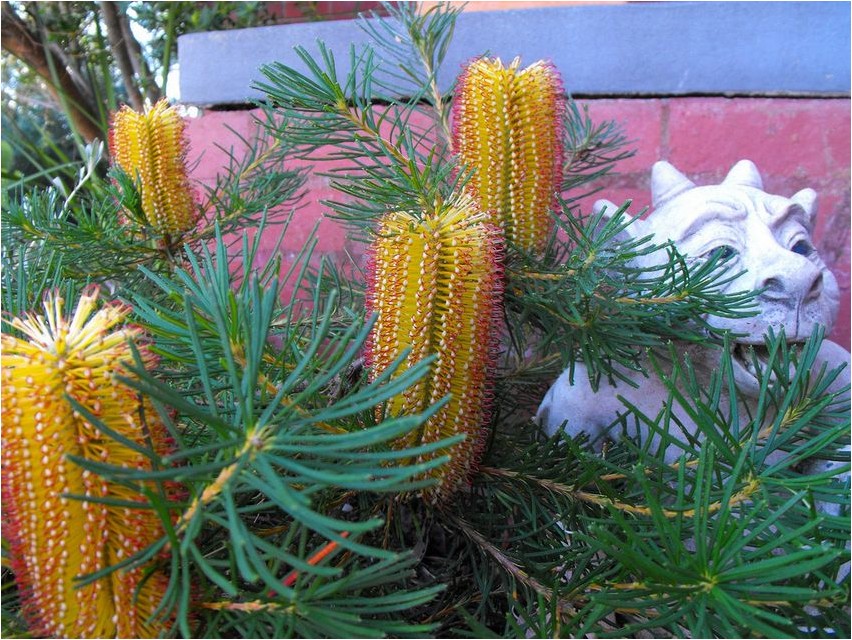
Banksia (lat. Banksia) is a beautifully flowering evergreen plant belonging to the Proteaceae family. Banksia received its name in honor of the famous explorer of the richest Australian flora, Joseph Banks.
Description
Banksia is a small shrub or tree of medium (from thirty to fifty centimeters) or quite large (up to twenty to thirty meters) height with very hard leaves of a wide variety of shapes. The bottom of these leaves are white-tomentose, and the edges are spiny-toothed.
Small banksia flowers have a rather unique structure and are collected in fairly thick and dense spikelets, each of which has from five hundred to a thousand flowers. And the shape of these flowers, depending on the type of banksia, can vary from highly cylindrical to almost spherical. It is noteworthy that many species of this plant are able to bloom throughout the year.
The flattened dry fruits of banksia are equipped with two hard (often woody) valves. In general, the fruits of this plant have an external resemblance to the cones of coniferous plants.
In total, this genus includes about one hundred and seventy species.
Where does it grow
Banksia is quite widespread on the Australian coast, from Tasmania to the northern territory. Occasionally it can be seen far from the ocean. And tropical banksia can also be found on the Aru Islands, as well as in New Guinea.

Usage
In floristry, banksia is widely used to create a wide variety of compositions and as a dried flower. It works especially well in contrast with shiny, smooth surfaces and varied lines. And plants in shades of silvery gray look great in Christmas arrangements! When cut, banksia can easily last up to two weeks.
Banksia is also grown in gardens with greenhouses, and for lovers of indoor floriculture, a number of special dwarf varieties have been bred.
Growing and care
In nature, banksia thrives on the poor soils of endless sandy deserts. This plant is perfectly adapted to both drought and sudden daily temperature changes, so even in indoor conditions it is quite possible to create conditions for it that are as identical as possible to the conditions of its homeland.
Since banksia is very light-loving, it is best to place it on light eastern or western windows. And with the onset of summer, when the thermometer rises above twenty degrees, it is recommended to take this beautiful plant out onto the loggia or into the garden. As for winter temperatures, the most optimal temperature for keeping banksia in winter will be in the range of five to ten degrees Celsius.
Banksia should be planted in fairly spacious pots that must be stable. As for the composition of the soil, ideally it should consist of sand taken in equal quantities, as well as humus, turf and heather soil. You can also prepare a substrate consisting of two parts sand (it should be coarse-grained), one part sphagnum moss (coarsely chopped) and one part perlite.
This beauty is quite undemanding when it comes to watering; the most important thing is to ensure that the earthen ball does not dry out too much. It will be enough to moisturize the banksia once a week. You should not deny her systematic spraying — they help to significantly revive this plant. And water for irrigation should ideally be slightly acidified and quite soft.
From spring to autumn, the plant must be fed with good mineral fertilizers with a relatively low phosphate content.
Banksia should be replanted annually, doing this until it grows to a meter — after this replanting is carried out every other year, in the spring, while simultaneously replacing the top soil layer with a fresh one. And propagation of this beauty occurs either by seeds or lignified cuttings.





