Kermek gmelina
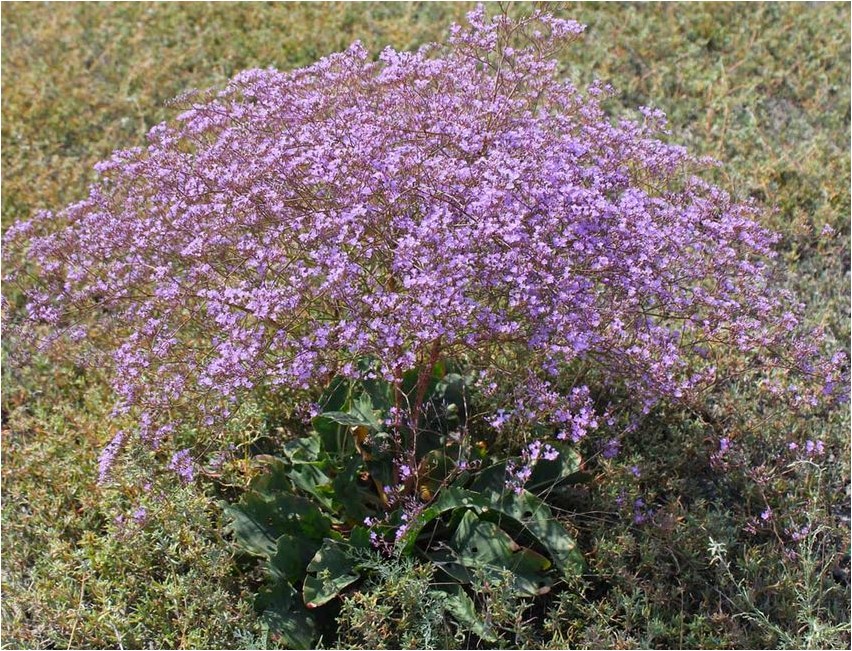
Kermek gmelina is one of the plants of the family called leadaceae; in Latin the name of this plant will be as follows: Limonium gmelini Kuntze.
As for the name of the Kermek gmelina family itself, in Latin it will be like this: Plumbaginaceae Juss.
Description of Kermek gmelin
Kermek gmelina is a perennial herbaceous plant, endowed with a long root and a rosette of basal leaves. The leaves, which are located in the basal rosette, are painted in bluish-green tones; they can be from ovate to oblong-obovate and broadly elliptical. At the top, such leaves are blunt, at the bottom they gradually narrow into petioles, which will be either equal to the plate or significantly shorter than it. The peduncles are round, and in the upper half they will be multiply paniculate-branched. The flowers of Kermek gmelin are colored in blue-violet tones, they are located either in a pyramidal or corymbose inflorescence, which will consist of dense and short spikes. The spikelets of this plant have two or three flowers.
Flowering of Kermek gmelina occurs at the end of the summer period. Under natural conditions, this plant is found in the south and southeast of the European part of Russia, and as an ornamental plant it grows in the south of Siberia, Kazakhstan and Central Asia. For growth, the plant prefers salt marshes, saline meadows, the shores of seas and salt lakes, as well as river valleys in wastelands.
Description of the medicinal properties of Kermek gmelin
Kermek gmelin is endowed with quite valuable healing properties, and for medicinal purposes it is recommended to use the roots of this plant, which should be harvested in late autumn. The presence of such valuable healing properties should be explained by the content in the roots of this plant of a significant amount of tannins, myricitrin glycoside, a small amount of alkaloids, gallic and ellagic acid.
The plant is endowed with hemostatic, anti-inflammatory and pronounced astringent effects.

A decoction and powder prepared from the roots of this plant is recommended for use against dysentery and enterocolitis, which will be accompanied by diarrhea. Also, such drugs should be used as a hemostatic agent for nasal, uterine and other bleeding. It should be noted that the roots of this plant are also used for tanning leather.
The roots of this plant contain about twenty-five percent tannins; in fact, it is for this reason that the roots are used not only for tanning leather, but also for dyeing them, as well as for dyeing wool. The roots are dug up in the autumn: they are washed, and damaged parts are also removed. Then the roots are dried, cut into pieces and dried under a canopy.
For diarrhea, it is recommended to use the following remedy based on Kermek gmelina: to prepare such a remedy, you will need to take one teaspoon of roots per one and a half glasses of water. The resulting mixture should be boiled for about eight to ten minutes, and then this mixture based on Kermek gmelina should be left to infuse for two hours, after which this mixture should be filtered very carefully. Take the resulting remedy based on this plant, one or two tablespoons two to three times a day before meals. It is important to remember that in order to achieve the greatest effectiveness when taking such a remedy based on this plant, you should not only carefully follow all the rules for preparing such a remedy, but also strictly follow all the rules for its use.