Black walnut
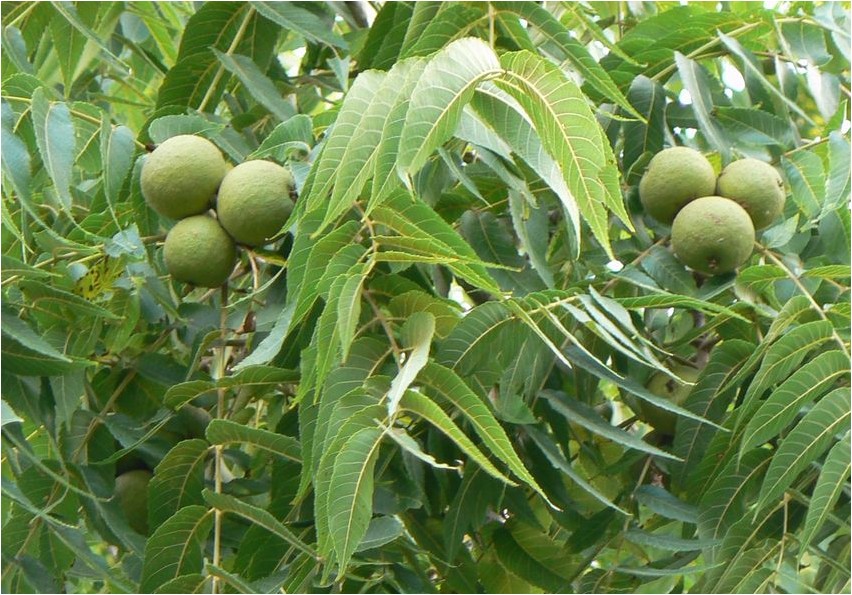
Black walnut (lat. Juglans nigra) is a representative of the genus Walnut of the Walnut family. In nature, the species is found mainly in North America. Typical habitats are mixed forests.
Characteristics of culture
Black walnut is a deciduous tree up to 40 m high with a trunk covered with black, deeply fissured bark. The leaves are green, compound, pinnate, alternate, consisting of 11-23 leaflets. The leaves are oblong-ovate or elliptical, with unequal sharp-toothed edges and a rounded base, and have a pungent balsamic scent. Flowers are dioecious, wind pollinated. Female flowers are collected in spikes or clusters, while male flowers are collected in complex inflorescences-catkins, the length of which varies from 6 to 12 cm. Black walnut blooms in the middle zone in mid-May.
The fruit is pear-shaped or spherical, light green, pubescent with glandular hairs, reaches 3. 5-5 cm in diameter. The peel of the fruit is thick, fleshy, and cracks when ripe. The nut is ovoid or round, pointed towards the apex, dark brown or black, and has a thick shell. The kernel is medium-sized, oily, edible. The crop begins to bear fruit 6-9 years after planting. The fruits ripen in late September — mid-October. Up to 5 fruits are formed on one axis.
Growing conditions
Growing black walnut in central Russia is problematic, since the plants are quite demanding on soil conditions and location. Black walnut is a light-loving crop, but its shade tolerance is not inferior to gray walnut and walnut. The plant is thermophilic, the optimal temperature for growth and development is 22-24C. Black walnut is not frost-resistant, although botanists have found that some representatives are able to withstand short-term frosts down t o-38C. The culture has a negative attitude towards spring frosts, especially for young, immature plants.
Black walnut is relatively drought-resistant (compared to Manchurian nut and walnut). Calmly tolerates short-term flooding. Soils are preferably neutral or slightly alkaline, fertile, loose. The presence of phosphorus and potassium fertilizers in the soil is welcome. Black walnut does not accept acidic, saline and swampy soils, as well as soils containing large amounts of nitrogen. In areas with an excess of nitrogen, plants slow down their growth, do not have time to ripen before the cold weather and, as a result, are damaged by frost. Black walnut needs protection from cold winds. Growing crops in lowlands is extremely undesirable.
Planting and care
The planting hole for black walnut is prepared 14-20 days before the intended planting. The depth and width of the hole depend on the size of the seedling”s root system. The roots of a young plant should be placed freely in the hole, this will have a positive effect on further growth and general condition. Phosphorus and potassium fertilizers, wood ash and humus must be added to the pit. Fertilizers should not come into contact with the root system, so before applying they must be thoroughly mixed with the top layer of soil. The seedling is lowered into the hole, covered with 1/2 of the soil, moistened abundantly, and after 5-10 minutes the remaining soil is added, after which it is compacted and mulched with organic material.

At a young age, black walnut needs regular watering. Adult plants require abundant moisture during prolonged drought, during periods of active growth and flowering. In the second half of summer, watering is reduced; this is necessary for the timely completion of nut growth, ripening of the wood and preparing it for persistent cold weather. In dry summers, moisture is also necessary at the time of fruit formation. Loosening the tree trunk circle is welcome. Sanitary trimmings are required, shaping ones are optional. Sanitary pruning involves removing dry, diseased and frostbitten branches. Thickening branches are also cut out.
Application
Black walnut kernels are used in cooking and medicine. Kernels are especially widely used in the confectionery industry. It is known that the kernels are rich in ascorbic acid, tannins, organic acids, carotenes, vitamins and flavonoids. Nuts are often included in dietary supplements and healing tinctures. Black walnut wood is used in the production of furniture, flooring, wall panels, helicopter and airplane propellers, gun stocks and musical instruments.





