A dubious shot
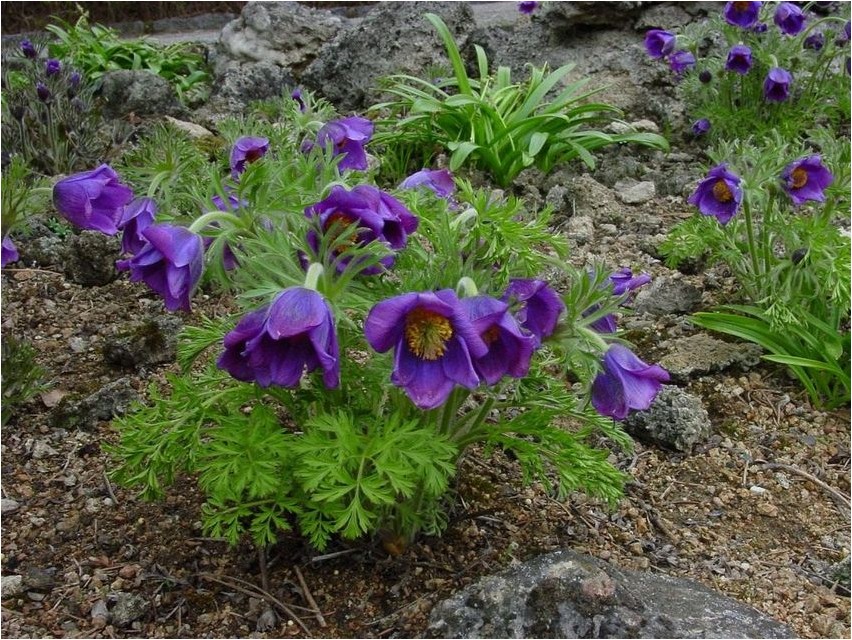
Pulsatilla ambiqua (Pasque Flower) is a member of the buttercup family. Its Latin name is Pulsatilla ambiqua (Turcz. ex G. Pritz.) Juz.
The Latin name for the Pulsatilla ambiqua family is Ranunculaceae Juss.
Description of Pulsatilla ambiqua (Pasque Flower)
Pulsatilla ambiqua (Pasque Flower) is a perennial herbaceous plant, growing between five and fifteen centimeters tall, and reaching up to thirty centimeters when fruiting. The rhizome of this plant is vertical. The rhizomes of Pulsatilla ambiqua (Pasque Flower) appear simultaneously with the flowers, and are borne on petioles covered with thin, erect hairs. The leaves of Pulsatilla ambiqua (Pasque Flower) are ovate in outline and imparipinnate. The stem of this plant is erect; the flowers will initially be drooping, later becoming erect. Furthermore, the flowers of the Pasque Flower will initially be spreading, later becoming bell-shaped and convergent. The leaflets of this plant will be about one and a half to three centimeters long and no more than one centimeter wide. These leaflets will be somewhat obtuse, always recurved at the tip, and have long, soft hairs on the outside. The leaflets of the Pasque Flower are colored in blue-violet tones, and can also be pink. The fruits of this plant will be sinuous and delicately pinnate, and their length will be about two and a half to three and a half centimeters. The flowering period of the Pasque Flower begins in May and ends in June. In the wild, this plant is found in the Altai Mountains of Western Siberia, as well as the Daurian and Angara-Sayan regions of Eastern Siberia. It prefers southern-facing mountain slopes, sands, and gravel in river valleys.
Description of the medicinal properties of Pasque Flower
The dubious lumbago is endowed with very valuable healing properties, and this plant has become especially widespread in folk medicine. Infusion and decoction prepared from this plant are indicated for use as a means of stimulating metabolism and toning the central nervous system. In addition, such drugs are used as expectorants, tonics and as an antidote for snake bites and poisoning. Externally, decoctions and infusions based on lumbago are used for eye diseases and rheumatism. An infusion prepared from the flowers of this plant is used externally for putrefactive infections, injuries and wounds.
It should be noted that lumbago is a poisonous plant and for this reason preparations based on this plant are strictly contraindicated for use in gastritis and nephritis.
For asthenia, it is recommended to use the following very effective healing remedy based on this plant: to prepare such a medicine, you will need to take one teaspoon of crushed lumbago herb per one glass of boiling water. The resulting healing mixture should first be infused for about two hours, after which such a mixture based on a questionable lumbago is recommended to be filtered very carefully. Take this remedy for asthenia three times a day, regardless of food intake, one tablespoon. Provided proper preparation, such a remedy based on a questionable lumbago will be very effective.

Dubious shot.





