St. John’s Wort
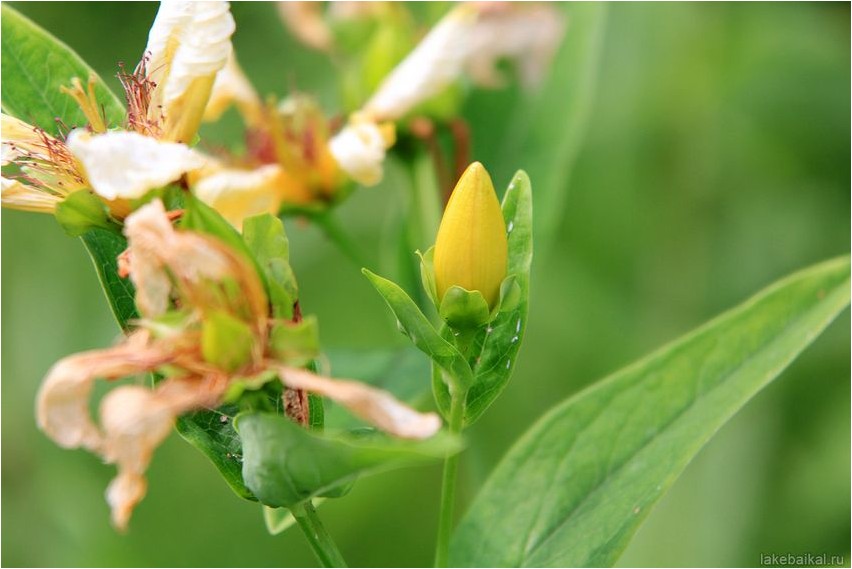
St. John’s Wort is a member of the St. John’s Wort family. Its Latin name is Hypericum ascyron L.
The family name itself is Hypericaceae Juss.
Description of St. John’s Wort
St. John’s Wort is a perennial herb. Its stem is erect, glabrous, smooth, and tetrahedral. Sometimes, this stem may be slightly branched at the top, and its height will reach approximately fifty to one hundred twenty centimeters. Its leaves are either oblong or oblong-ovate, opposite, pointed, entire, and clasping, with a glaucous undersurface. St. John’s Wort flowers are quite large, and can be solitary or clustered in groups of three to five at the ends of the stem or branches. The petals are also either obovate or oblong-ovate. The stamens are quite numerous, fused into five fascicles. The ovary is brown, five-locular, and ovoid. The fruit of this plant is a brown capsule that is oblong-ovate. The seeds are oblong, quite small, brown, cellular, and have a membranous wing located on one side.
St. John’s wort blooms from June to July. It is noteworthy that this plant is ornamental. In the wild, the plant is found in all regions of Western Siberia, with the exception of Verkhne-Tobolsk, as well as in the Daurian and Angara-Sayan regions of Eastern Siberia, and in Primorye and the Amur region of the Far East. As for the general distribution of this plant, it is found on the Korean Peninsula, in Northeast China, Japan, Canada, and the United States.
Description of the Medicinal Properties of St. John’s Wort
St. John’s Wort has very valuable medicinal properties, and the herb is recommended for medicinal purposes. The herb includes the flowers, leaves, and stems. These valuable medicinal properties are explained by the plant’s content of hyperin, essential oil, tannins, leucocyanidins, quercetin, quercitrin, as well as phenolic acids and their derivatives: caffeic and chlorogenic acids.
As for traditional medicine, infusion and decoction of St. John’s wort are widely used here. Such remedies are used for dizziness, headaches, palpitations, pancreatitis and gastritis. These drugs can also be used as a diuretic and anticonvulsant for eclampsia. The roots strengthen the stomach and are a valuable anti-fever remedy. The seeds of this plant are used for scrofula, malaria, abscesses and also as a means to regulate the menstrual cycle, as a diuretic and antifever. The plant’s herbs are used to prepare baths that are taken for rheumatism.

A decoction prepared from the herb of this plant is recommended to drink for bloody vomiting, hemoptysis, uterine bleeding, hepatitis and nosebleeds. Externally, this decoction can be used in the form of rubbing and lotions for burns, eczema, purulent wounds and external traumatic bleeding. This decoction is prepared from an arbitrary amount of grass or St. John’s wort juice.
For headaches and dizziness, it is recommended to use the following remedy: to prepare it, take one tablespoon of dry crushed herb per glass of boiling water. The resulting mixture is infused for two hours and then filtered. This remedy is taken three times a day before meals, two tablespoons.





