Jasmine bush
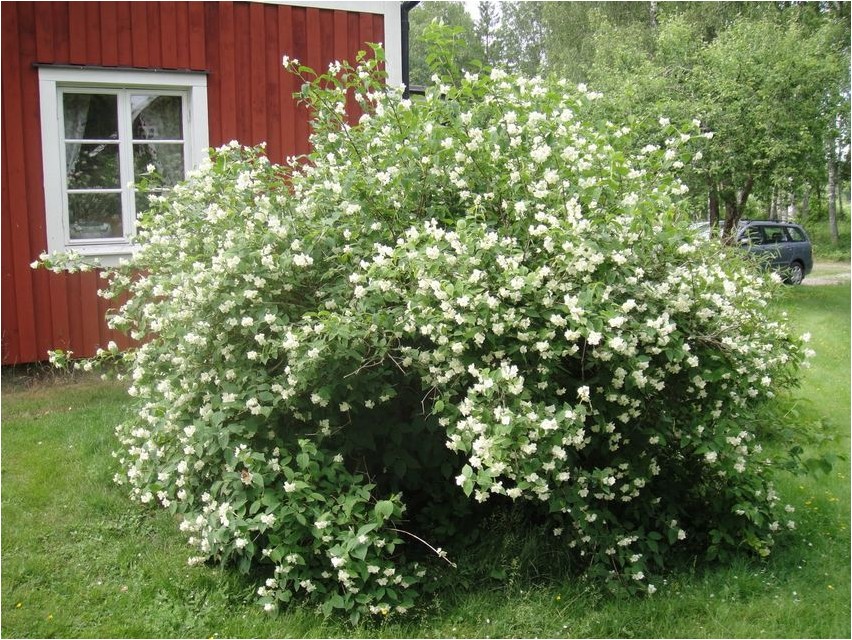
Shrub jasmine is one of the plants of the family called Oliveaceae; in Latin the name of this plant will be as follows: Jasminum fruticans L.
As for the name of the bush jasmine family, in Latin it will be: Olaceae Hoff. et Link.
Description of bush jasmine
Bush jasmine is a perennial shrub whose height is about one to one and a half meters. This shrub is erect, it is endowed with flexible twig-like and angular-striped branches, painted in green tones. The lateral leaves are elongated, they can be either sessile or can sometimes taper into a very short petiole. The terminal leaf of this plant will be strongly narrowed and spatulate, the length of such a leaf will be about one or two centimeters, and the width will be equal to half a centimeter or one centimeter. All the leaves of the bush jasmine are ciliated at the edges, they are bare on both sides, the leaves are dark green on top, and slightly lighter on the bottom. The flowers are located at the ends of the side branches in semi-umbrellas of two to four pieces. The calyx of this plant will be short-bell-shaped and it is endowed with long subulate-shaped lobes. The corolla of the bush jasmine is painted in bright yellow tones; it is endowed with a rather narrow cylindrical tube, the length of which is twice as long as the calyx. The fruit of this plant is a berry, the diameter of which is even less than one centimeter.
Shrub jasmine blooms in June. Under natural conditions, this plant can be found in all regions of the Caucasus, in the Mountainous Turkmen region of Central Asia and in the mountainous part of Crimea. For growth, this plant prefers bushes, screes, dry gravelly slopes, rock crevices, and calcareous slopes. The plant grows in coniferous and oak forests. It is noteworthy that the plant is not only decorative, but also a rather valuable honey plant.
Description of the medicinal properties of bush jasmine
Shrub jasmine contains flavonoids, and the bark of this plant contains phenols and its derivative substance syringoside, the bark and leaves contain alkaloids, while the leaves contain ursolic acid. The flowers of this plant contain alkaloids, and fatty oils have been found in the seeds.
It is noteworthy that the experiment proved that the aqueous extract of this plant is endowed with fairly high protistocidal activity. Also in the experiment, extracts of branches of young leaves and fruits have the ability to exhibit bactericidal activity.

For bronchitis and bronchial asthma, it is recommended to use the following property based on bush jasmine: to prepare it, take one tablespoon of crushed dry young branches of this plant per glass of water. The resulting mixture should be boiled over fairly low heat for four to five minutes, and then this mixture is left to infuse for one hour, after which this product is filtered very carefully. Take this remedy based on this plant, one or two tablespoons three times a day before meals. It should be noted that in order to achieve greater effectiveness when taking such a product based on fruticose jasmine, it is recommended to strictly follow not only all the rules for preparing this product, but also carefully follow all the rules for its administration.
It is noteworthy that even in medieval Armenia such a decoction was used to combat bronchial asthma and bronchitis.





