Ardisia
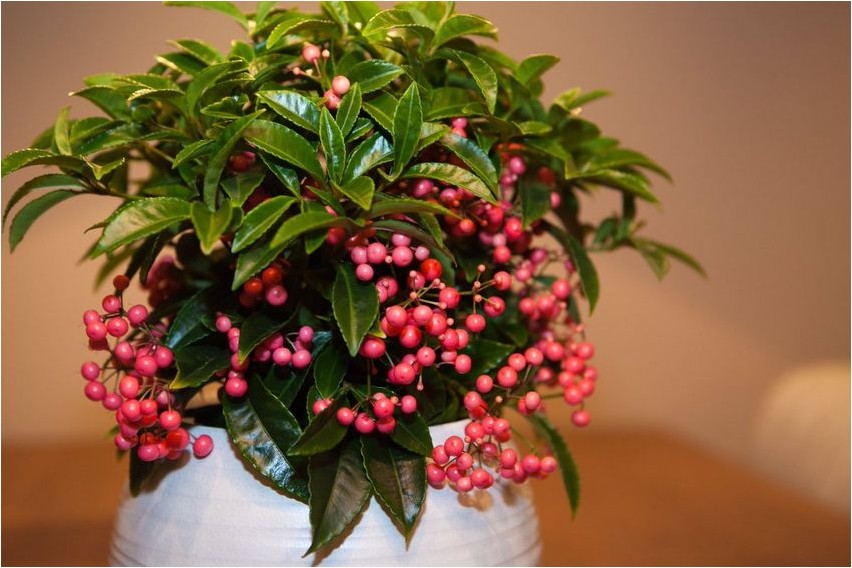
Ardisia (lat. Ardisia) is a woody tropical evergreen plant from the Myrsinaceae family.
Description
Ardisia is a spectacular decorative deciduous tropical woody plant. Its oblong-lanceolate, leathery alternate leaves are usually wavy at the edges, and they can be either whorled (each whorl has three leaves) or opposite. And the leaves of this plant are characterized by a very spectacular shine.
Ardisia flowers boast a fairly bright pink or red color. And they are located in axillary or apical paniculate or corymbose inflorescences. Each flower is equipped with a five-part corolla, a five-part calyx and five long protruding stamens.
The fruits of this plant look like decorative berries of a rich orange-red color. They look especially impressive against the backdrop of lush green leaves.
In total, there are from four hundred to five hundred varieties of ardisia in the world.
Where does it grow
Under natural climatic conditions, ardisia can be seen in the subtropics of distant Southeast Asia. This plant is quite widespread in Australia and America, as well as on a number of Pacific islands — where ardisia grows mainly in the tropical zone. Most often, ardisia can be found in forest areas.

Usage
Ardicia is incredibly popular in floriculture — this is due not only to its excellent decorative qualities, but also to its relative unpretentiousness.
Growing and care
Ardisia can boast of an average degree of difficulty in growing, that is, with proper perseverance, growing it yourself is more than possible. The main feature of this plant is that in different seasons of the year it is necessary to maintain different conditions for it: in winter it is usually installed on southern windows, and with the onset of summer it is transferred to northern ones. At the same time, in summer, ardisia should be placed as far as possible from direct sunlight or properly shaded, and in winter, the beautiful plant should be as close to the light as possible. As for winter temperatures, they must be maintained in the range of ten to twelve degrees — if you keep ardisia in winter at low temperatures, its fruiting period will increase significantly.
The beautiful ardisia is generally very undemanding when it comes to soils, but it will do best in a soil mixture with the following composition: turf soil (two parts) — peat soil (one part) — leaf soil (one part) — sand (one part). Universal ready-made earthen mixtures are also quite suitable for planting it. The main thing is that the soil must have good drainage!
Winter watering should be more scarce than summer watering, but in summer ardisia should be watered abundantly and systematically sprayed. Despite the fact that this beauty does not tolerate drying out very well, it is important to try to avoid stagnation of water. Whether to feed a plant or not depends entirely on its well-being. The main thing is to try to avoid drafts, since under their influence the beautiful ardisia can easily get sick.
To form the crowns of ardisia, timely pruning is necessary — with the onset of spring, the shoots of this plant are necessarily shortened. And if small swellings with bacteria appear on the plant, they should not be removed under any circumstances, otherwise the ardisia will immediately begin to wither (inexperienced gardeners, seeing such swellings, often believe that the ardisia is sick, and rush to immediately cut off these swellings along with the bacteria that are most beneficial for the plant).
Ardisia can be propagated either by apical cuttings or seeds, or by air layering.