Angelica officinalis
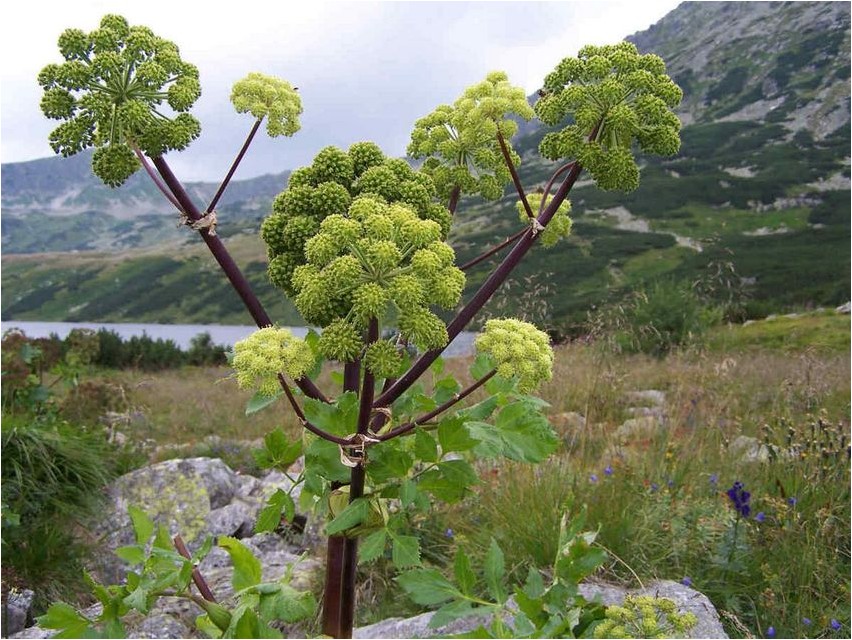
Angelica officinalis is one of the plants of the family called Umbellaceae; in Latin the name of this plant will be as follows: Archangelica officinalis L.
As for the name of the Angelica officinalis family itself, in Latin it will be: Apiaceae Lindl.
Description of angelica officinalis
Angelica officinalis is either a perennial or biennial plant that is endowed with a hollow stem. The leaves of this plant are large and can also be either double- or triple-pinnate. The height of angelica officinalis leaves reaches two meters. The rhizome is short and vertical, as well as brown and endowed with numerous adventitious roots. The stem of this plant is erect, in the lower part it will be colored in reddish tones, and in the upper part – in purple tones. The flowers of this plant are small, greenish-brown in color, they will be collected in spherical multi-rayed umbrellas. The fruit of Angelica officinalis is a flat two-seeded plant.
Angelica officinalis blooms from June to July. Reproduction of this plant occurs through seeds. Under natural conditions, the plant is found in the European part of Russia, Western Siberia, Belarus, the North Caucasus and Ukraine.
For growth, angelica officinalis prefers flooded meadows, marginal swamps, forest and steppe zones: less often this plant is found along the banks of rivers, ditches and lakes, as well as in floodplain meadows. It is noteworthy that sometimes the plant will form thickets. The plant lives in places with high humidity and prefers rich soils, the reaction of which will be either neutral or slightly acidic.
Description of the medicinal properties of angelica officinalis
For medicinal purposes, it is recommended to use the rhizomes and roots of this plant: such raw materials should be harvested in late autumn. The presence of such valuable healing properties is explained by the plant’s content of pinene, borneol, felandrene, essential oil, bitter and tannins, resins, sugar, numerous coumarins, as well as malic, valeric and angelic acid. The leaves and flowers of Angelica officinalis contain the flavonoiddiosmin, and coumarin derivatives, essential and fatty oils were found in the fruits.

The plant possesses valuable diuretic, anti-inflammatory, expectorant, antispasmodic, diaphoretic, and antimicrobial properties. Furthermore, the plant enhances intestinal secretory and motility and can reduce fermentation processes. Decoctions and infusions based on angelica are used for acute and chronic neuralgia, nervous exhaustion, rheumatism, lumbago, gout, bronchitis and bronchial asthma, acute and chronic laryngitis, as well as hepatitis, chronic colitis, and chronic gastritis with secretory insufficiency.
Infusions of angelica rhizomes and roots are recommended for urinary retention and severe fermentation and putrefaction in the intestines. As for the alcohol tincture, this remedy is used externally for gout, myositis, myalgia, and rheumatism.
For chronic bronchitis and gastritis with secretory insufficiency, as well as for hepatitis, flatulence, and bronchial asthma, the following remedy is recommended: to prepare it, take ten grams of crushed roots and rhizomes per two hundred and fifty milliliters of boiling water. The resulting mixture should be steeped in a water bath for one hour, then very carefully filtered. Take half a glass of this remedy.





