Chickweed
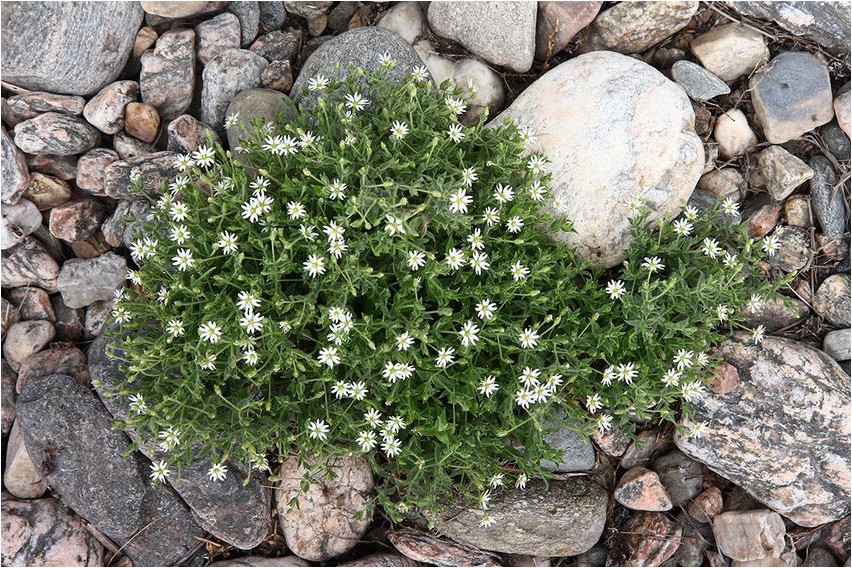
Chickweed is one of the plants of the family called Cloveaceae; in Latin the name of this plant will be as follows: Stellaria dichotoma L.
As for the name of the chickweed family itself, in Latin it will be: Caryophyllaceae Juss.
Description of chickweed
Chickweed is a perennial herbaceous plant whose height reaches thirty centimeters. The root of this plant will be vertical and cylindrical, its thickness is five to fifteen millimeters, while its length will be more than twenty centimeters. The stems will be numerous from the very base, they are branched and dichotomous, and also form a rather wide spherical bush. The height of such a bush will be approximately thirty centimeters. The leaves of this plant are numerous, sessile, more or less fluffy or smooth. The length of such leaves of chickweed will be about half a centimeter or two centimeters, and the width reaches about twelve millimeters. The lower leaves will be wide, while the upper ones will be narrower. The sepals of this plant will be lanceolate, glandular-fluffy and sharp, and their length is four to four and a half millimeters. The petals of chickweed are painted white, the capsule will be almost spherical in shape, and its diameter will be about three millimeters.
Flowering of chickweed occurs during the period from May to August. Under natural conditions, this plant is found in the Altai region of Western Siberia, in the Amur region of the Far East, as well as in all regions of Eastern Siberia, with the exception of the Yenisei region. For growth, the plant prefers dry steppes and rocky slopes. It should be noted that this plant is also decorative.
Description of the medicinal properties of chickweed
Chickweed is endowed with very valuable medicinal properties, and it is recommended to use the roots of this plant for healing purposes. The presence of such valuable healing properties is explained by the content of flavonoids in the aerial part of the plant, and coumarins in the roots.
In folk medicine, the root powder of this plant is used to treat a variety of pulmonary ailments. The roots of the common chickweed are also included in herbal teas for heart disease. A decoction of the root can also be used as a general tonic, and is also used for vascular atherosclerosis and various infectious diseases, such as smallpox and anthrax.

For vascular atherosclerosis and as a general tonic, the following chickweed-based remedy is recommended: To prepare it, take one teaspoon of crushed roots per cup of boiling water. Heat the resulting mixture in a water bath for approximately seven to eight minutes, then let it steep for one hour. Afterward, strain the mixture thoroughly and add boiled water to bring the original amount up to the original dosage. Take one to two tablespoons of this remedy three to four times daily before meals. To ensure this remedy is effective, strictly follow all preparation and administration instructions.
For pneumonia and bronchitis, the following remedy based on chickweed is effective: take two grams of root powder and dilute it with a small amount of boiled water. Take this remedy three times daily.





