Codonopsis fine-haired
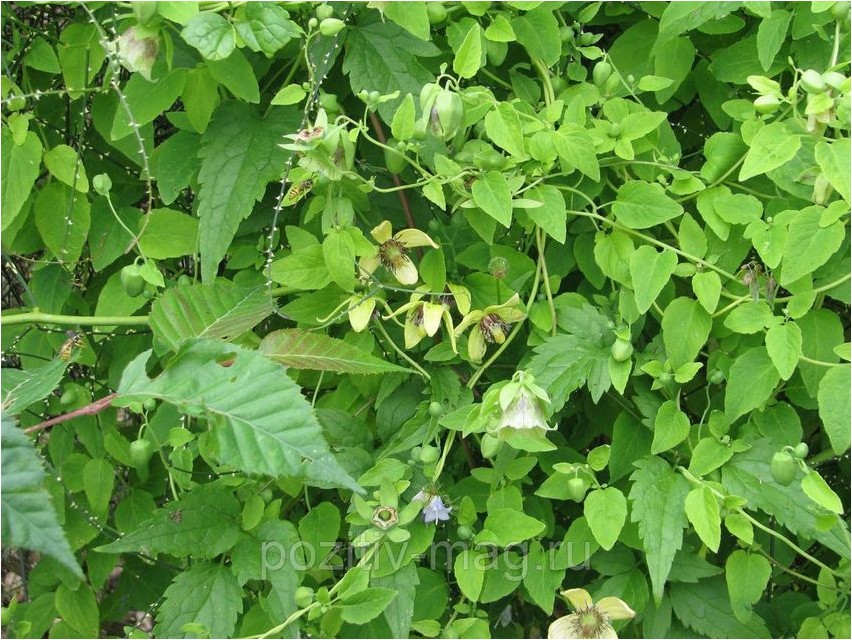
Codonopsis small-haired is one of the plants of the family called bellflowers; in Latin the name of this plant will be as follows: Codonopsis pilosula.
As for the name of the small-haired codonopsis family itself, in Latin it will be like this: Campanulaccae Juss.
Description of codonopsis small-haired
Codonopsis small-haired is a perennial climbing plant, the length of which reaches one meter. The root of this plant will be quite thick, hard, radish-shaped, somewhat bumpy and webbed-wrinkled. This root is painted in grayish tones, and its diameter is about one and a half centimeters. The stem of this plant is climbing, at the very base it will be covered with rather small bristly hairs. This stem is smooth and bare, it is very long and branched. The leaves of Codonopsis small-haired are petiolate, broadly ovate or ovate, they are pointed, thin, and can be either entire or almost entire. Below, such leaves are painted in bluish tones, along the edge they will be slightly hairy; in a young plant, such leaves will be somewhat bristly-hairy on top, later they become bare.
The flowers of Codonopsis small-haired are solitary, they are colored yellowish with a purple tint, and they will also be endowed with darker specks and thin pedicels. The calyx teeth of this plant are bare or slightly downy, and also oblong. The corolla is bare and broadly bell-shaped; up to half of this corolla is cut into sharp, straight and oblong-lanceolate lobes. The fruit of Codonopsis small-haired is a three-locular capsule, which will open with valves from a flat top. The seeds of this plant are shiny, dark and wingless. This plant blooms from August to September. under natural conditions, codonopsis small-haired is found in the Far East: namely, in the south of the Amur region and Primorye. For growth, this plant prefers forest edges, thickets of bushes, banks of rivers and streams.
Description of the medicinal properties of codonopsis small-haired
Codonopsis fine-haired is endowed with very valuable healing properties, and it is recommended to use the roots of this plant for medicinal purposes.
As for Chinese and Korean medicine, a decoction prepared from the roots of Codonopsis parsifolosa has become quite widespread. Both Chinese and Korean medicine consider this plant to be the most important substitute for ginseng. A decoction of the roots of this plant is used as a tonic and stimulant, which is recommended for nephritis, diabetes, cervical cancer, hypertension, rheumatism, anemia, encephalitis, dysmenorrhea, baldness and joint pain.

Codonopsis fine-haired is endowed with restorative, hemostatic, antitussive, expectorant, androgenic, analgesic and antidiarrheal effects.
For rheumatism, it is recommended to use the following remedy based on this plant: to prepare such a remedy you will need to take fifteen to twenty grams of dry crushed roots per two glasses of water. The resulting mixture should be boiled for seven to eight minutes, then left to steep for about two hours and strain very thoroughly. Take the resulting product based on codonopsis parsifolosa three to four times a day, one-third of a glass.





