Beans
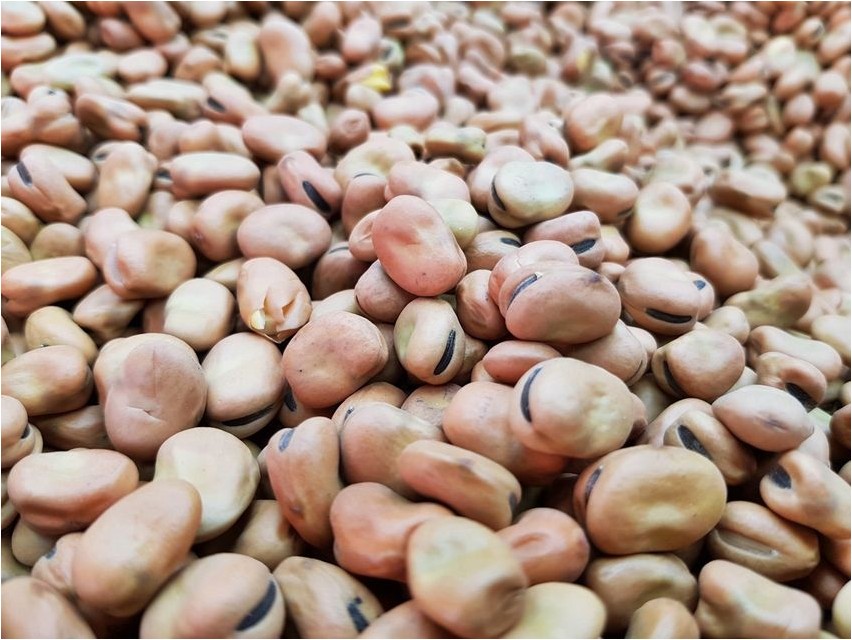
Beans (lat. Vicia faba) — leguminous crop; an annual plant belonging to the Legume family. The homeland is the Mediterranean.
Description
Beans are represented by plants with erect, highly branched, non-lodging, stems up to 1 m high with pronounced edges. The root system is taprooted, individual roots reach a depth of 90 cm. The leaves are green, compound, oblong, elliptical in shape, pointed at the ends.
The flowers are white or creamy-white, with a bright spot, they are quite large, moth-like, located in several pieces in the axils of the leaves, and have a weak aroma. The beans bloom 25-27 days after germination. Beans ripen (depending on the variety) in 1. 5-2 months.
The fruits are beans with seeds. The length of the beans is 10 cm, in an unripe state the fruits are green, soft, ready to eat — stale, brownish. The fruits contain oval green, purple, yellow or white seeds.
Growing conditions
Beans are a light-loving crop; they prefer light, peaty, permeable, moderately moist soils with a neutral pH. Strongly acidic soils are preliminarily limed, otherwise the plant produces low yields of poor quality. Most of the crop varieties are cold-resistant, the seeds hatch at a temperature of 2-5C, and the seedlings easily tolerate frosts down t o-7C. The best predecessors are cucumbers, tomatoes, cabbage and potatoes. It is not recommended to grow the plant after peas, beans, beans, lentils, soybeans and peanuts.
Landing
Beans are planted in late April — early May. The area for planting is prepared in advance, the soil is thoroughly dug up, manure and mineral fertilizers are applied. The seeding depth is 6-7 cm, the distance between plants should be 10-15 cm, between rows — 35-40 cm. Beans can also be grown through seedlings.

Quite often, before planting, gardeners soak the seeds until the sprouts sprout, but this is wrong. Experienced agronomists claim that this procedure causes biochemical processes that have an extremely negative effect on the seeds.
Care
Beans require moderate and regular watering, especially during flowering and fruit formation. Lack of moisture has a detrimental effect on development and yield. At the moment of flowering, the growth point is pinched off; this procedure will allow the plants to feed intensively.
Weeding and aeration are equally important for the crop. When the crop reaches a height of 50 cm, the soil between the rows is thoroughly loosened to a depth of 10 cm. Hilling is then carried out. This will increase the beans” resistance to adverse factors. Fertilizing is carried out a couple of weeks after emergence; slurry is ideal for this purpose.
Harvesting
The timing of harvesting depends on the intended use of the beans. If they are intended for consumption, they are picked immature. If they are intended for storage, they are left until fully ripe. The stems with the fruits are cut close to the root and dried. Then the seeds are shelled, aired, and stored in containers. Unripe seeds are removed from the crop, as they rot over time.
Disease and Pest Control
Aphids are the most common and dangerous pest of the crop. It typically appears during hot weather. To combat the pest, plants are pruned and then sprayed with malathion. Weevils can cause irreparable damage to crops, devouring the leaves of new shoots. Dandelion infusion can help combat the pest.
Rust is a dangerous plant disease that attacks foliage and stems. It appears as yellowish spots that later develop into pustules. Ascochyta blight, a fungus that causes dark brown spots on leaves, is also dangerous. At the first signs of these diseases, plants are removed and burned.