Elf angustifolia
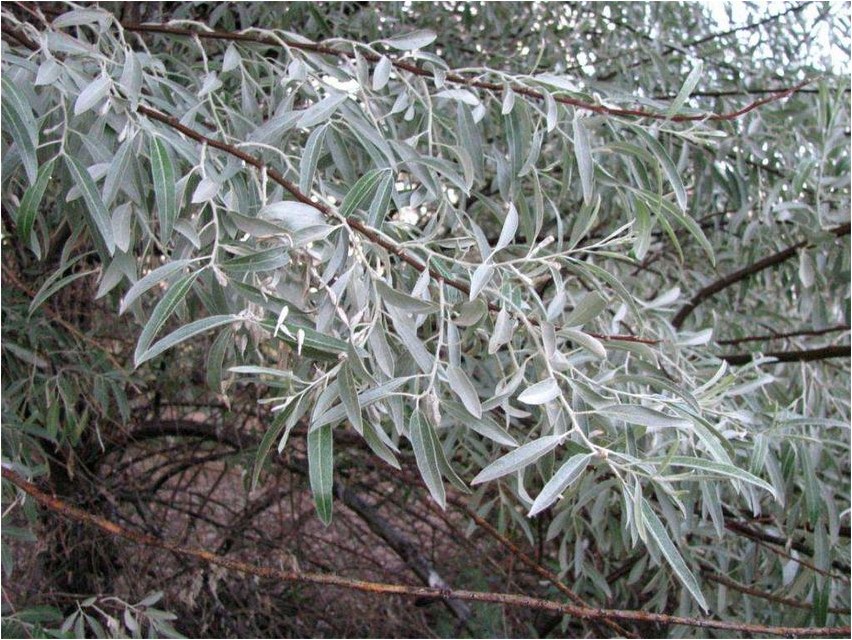
Elaeagnus angustifolia L. is one of the plants of the family called Elaeaceae; in Latin the name of this plant will be as follows: Elaeagnus angustifolia L.
As for the name of the angustifolia family itself, in Latin it will be: Elaeagnaceae Juss.
Description of Eleven angustifolia
Eleven angustifolia is known by numerous popular names: jida, wild olive, kush zhiyda, pshati, igda, dzhicherdak. Elf angustifolia is a tree-like shrub from the Elaf family, endowed with red-brown bark. The stem spines of this plant are quite large, the leaves will be narrow lanceolate. The flowers are quite small in size, endowed with a very fragrant aroma and painted in bright yellow tones. It is noteworthy that Eleven angustifolia is a very good and early honey plant. The fruits of this plant are oval in shape, they are mealy and appear as drupes, which in shape will resemble an olive, and they are colored yellowish-brown. The fruits have a very sweet and slightly astringent taste.
The flowering of Eleven angustifolia occurs in the period from May to June, while the ripening of fruits occurs already in September-October. It is noteworthy that this plant has cultivated varieties endowed with mealy fruits. In the wild, under natural conditions, this plant is found in the south of the European part of Russia, the Caucasus, North America, Central Asia and Siberia. For growth, this plant prefers forests and the banks of water bodies. As an ornamental plant, Elf angustifolia grows on the edges of forests and along river banks.
Description of the medicinal properties of Eleven angustifolia
Elf angustifolia is endowed with very valuable healing properties, and it is recommended to use the flowers, leaves and fruits of this plant for medicinal purposes. Such fruits are endowed with very effective astringent, anti-inflammatory, diuretic, analgesic, enveloping and anthelmintic effects. In addition, such fruits can increase sputum production in various diseases of the respiratory organs. It is noteworthy that sometimes it is permissible to use the fruits of this plant instead of blueberries as an astringent, especially for catarrh of the gastrointestinal tract and childhood diarrhea.
In folk medicine, the narrow-leaved oleaster is also quite widespread. Traditional medicine recommends using concentrated tannins and colloidal substances from the berries as an astringent. Furthermore, a decoction made from the berries is recommended for use against worms, scurvy, and dropsy, and as an expectorant and diuretic for pneumonia and bronchitis.

The dried berries and their decoction are used for colitis, various stomach ailments, catarrh of the upper respiratory tract, and childhood diarrhea, while the leaves of the narrow-leaved oleaster are used for rheumatism, radiculitis, and gout as poultices. To prepare such poultices, wrap steamed leaves of the plant in gauze, and then apply the poultices to the affected area. The essential oil of the narrow-leaved oleaster flowers is used to improve heart function; to do this, simply smell the essential oil. To promote faster healing and clear wounds of pus, it is recommended to use fresh oleaster leaves, which are applied to such wounds. Furthermore, this essential oil-based infusion is used to stimulate cardiac function and is also used for inflammatory diseases of the upper respiratory tract.





