Angelica fringed
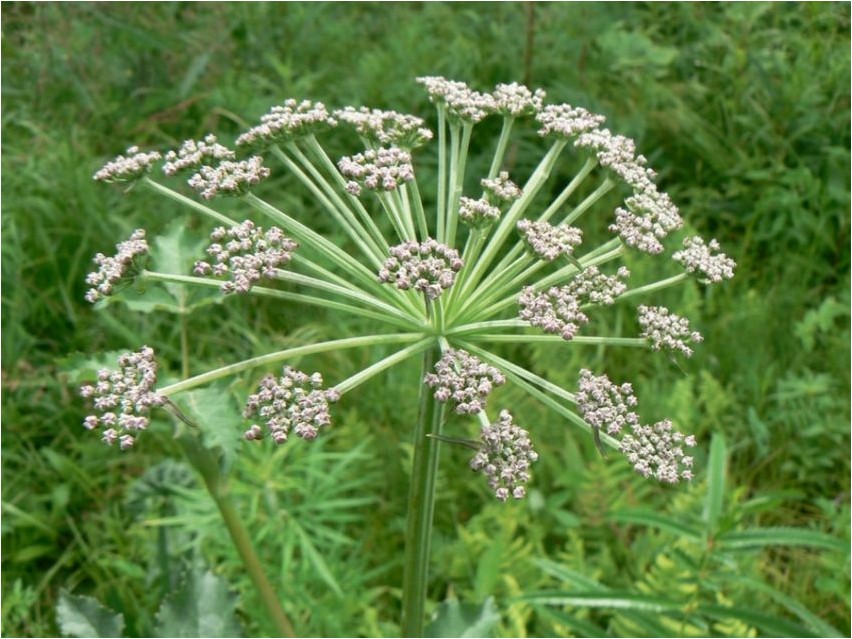
Angelica fringe is one of the plants of the family called Umbellaceae; as for the very name of this plant, in Latin it will sound like this: Angelica cinota Boissien.
As for the name of the angelica family itself, in Latin it will be like this: Apiaceae Lindl.
Description of angelica fringe
Angelica fringe is a perennial herbaceous plant whose height can reach two meters. The inside of the plant stem is hollow, branched and bare. The length of the basal leaves reaches forty centimeters, and their width is approximately thirty centimeters. Such leaves will be thrice-pinnate, and the stem leaves will be thrice-pinnate; on the petioles, such leaves will be shorter than the blade. The umbrellas will have about twenty to forty rays, their length in diameter will be about ten to twenty centimeters, they are endowed with sharp and rough pubescent rays, and the wrapper will be absent. The umbrellas are endowed with short pubescent pedicels, the petals will be white in color, and their length is approximately one millimeter. The fruits are broadly ovoid or almost round, their length is five millimeters and their width is about four millimeters.
Flowering of angelica fringed occurs during the period from June to August. Fruit ripening occurs in August-September. Under natural conditions, this plant can be found in the Far East: namely on Sakhalin, the Amur region and Primorye. For growth, angelica fringe prefers places in oak forests, tall grasses and thickets.
Description of the medicinal properties of angelica fringe
Angelica fringe is endowed with very valuable healing properties, and it is recommended to use the roots of this plant for medicinal purposes.
It is noteworthy that the root extract of this plant is endowed with antitumor activity. As for traditional medicine, a decoction of the roots and rhizomes of angelica fringe is used for headaches and toothaches, as well as for neuralgia, in addition as a gastric, wound-healing, analgesic and antirheumatic agent. External use of such a remedy is possible as an anti-inflammatory for hemorrhoids and skin diseases.

A remedy based on angelica marginata is quite effective for eczema: to prepare it, take ten grams of the roots and rhizomes of this plant per glass of water. The resulting mixture should be simmered over low heat for four to five minutes, then left to steep for one hour, after which it should be thoroughly strained. Take one-third of a glass of this remedy three times daily.
For gout, as well as rheumatism and lower back pain, a very effective remedy based on angelica marginata is recommended. To prepare this remedy, you need to make an alcohol tincture in a ratio of one part to thirty parts. This remedy is used as a rub for all of the above-mentioned ailments.
Notably, the essential oil of this plant has the ability to increase and stabilize appetite: such remedies can even be used to combat anorexia nervosa. The oil from this plant stimulates estrogen production, which not only alleviates postpartum symptoms in women but also helps restore menstruation and makes it easier to endure particularly painful periods. This plant’s oil also acts as an antiseptic for the genitourinary system, making it useful for both male and female infertility.





