Cerulean triloba
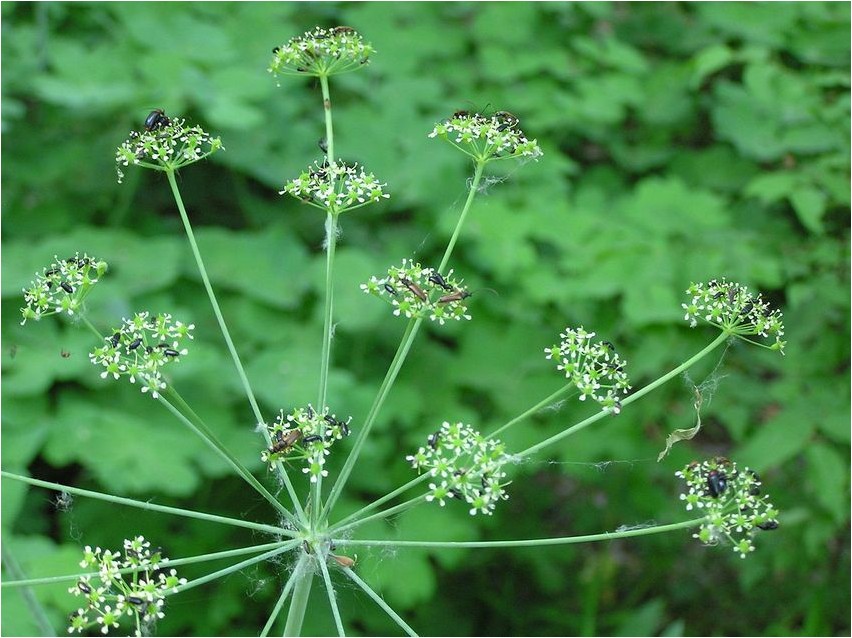
The three-lobed azure is one of the plants of the family called umbelliferae; in Latin the name of this plant will be as follows: Laser trilobum (L.) Borkh. (Siler trilobum (L.) Grantz.).
As for the name of the three-lobed azure family itself, in Latin it will be like this: Apiaceae Lindl.
Description of the three-lobed bluebird
Bluegrass triloba is a perennial herbaceous plant, the height of which will fluctuate between sixty and one hundred and fifty centimeters. The stems of this plant are straight and branched, while the basal leaves will be long-petiolate, double- or triple-triple. The leaves of this plant are almost round; they can be either cut or whole. In this case, the upper leaves of the three-lobed bluegrass will be sessile and less complex, they are endowed with swollen sheaths. The inflorescences of this plant are in the form of umbrellas, and in diameter they reach a length of up to twenty-five centimeters. This plant does not have an involucre, while the involucres will consist of small lanceolate-shaped leaves. The petals of the three-lobed bluegrass are painted white. The fruits of this plant are flat, smooth and elliptical double seeds.
Under natural conditions, the three-lobed azure is found in the territory of Belarus, Moldova, in the East Caucasus, West Caucasus, Dagestan and Pre-Caucasus regions of the Caucasus, as well as in the European part of Russia in the following areas: Zavolzhsky, Volga-Kama, Volga-Don and Black Sea. As for the general distribution, this plant can be found in Iran, Western Europe, Asia Minor, Armenia, North Africa and the Balkan Peninsula. For growth, the plant prefers edges, calcareous slopes, cliffs, thickets of bushes, oak and oak-hornbeam forests.
Description of the medicinal properties of the three-lobed bluegrass
The three-lobed azure is endowed with very valuable healing properties, and it is recommended to use the roots and fruits of this plant for medicinal purposes.
The presence of such valuable healing properties should be explained by the content of arsthenium laserolide, sesquiterpene lactones, coumarins, acetylene compounds, trilolobolide, oxypeucedanine, prangenin or heraclenin, as well as isotrilolobolide.

The herb of this plant contains essential oil, while the leaves contain the flavonoid 7-glycoside luteolin and vitamin C. The fruits of the blue azure plant contain essential oil containing alpha-pinene, perillic alcohol, perillic acid, alpha-phellandrene, coumarin, silerin, and perillaldehyde. Notably, the lactones in the roots of this plant possess valuable antibacterial properties.
A decoction made from the fruits of this plant is recommended for respiratory infections, coughs, intestinal ailments, and is also a highly therapeutic remedy that stimulates the central nervous system. It is also worth noting that experiments have shown that the plant also has hypotensive properties. In veterinary medicine, a decoction of the fruits of this plant is widely used and is recommended for flatulence. It’s worth noting that the fruits of the three-lobed azure plant were used to make compotes, various meat dishes, and a special type of sausage. The essential oil from the fruits of this plant is also used in perfumery, and it is also used to flavor fruit essences.
Louiseania, or three-lobed almond.





