Saintpaulia ionantha
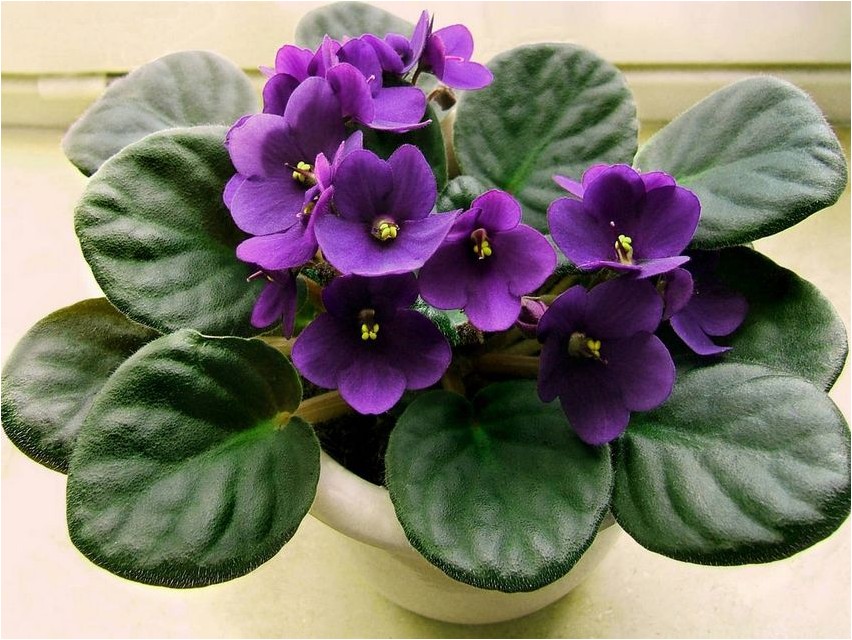
Saintpaulia ionantha (Latin: Saintpaulia ionantha) is a herbaceous flowering plant of the genus Saintpaulia in the Gesneriaceae family.
Native to Africa, this plant has become a staple on windowsills and flower shelves around the world. Attractive, thick, dark green leaves, a variety of flower colors and shapes, almost continuous blooming year-round, and a compact plant make Saintpaulia ionantha a popular houseplant.
What’s in a name?
The Latin generic name commemorates two people, a son and his father. The son was the man who first discovered one of the genus’s species, finding it in a crevice in a mossy rock in the Usambara Mountains, located in southeastern Africa. As commandant of the German colony, Walter von Saint-Paul (January 12, 1860 – December 12, 1940) was not without sentimentality and vividly described his discovery, whose petals and flower shape he found similar to the violet, only much more delicate. He sent seeds to his father, Ulrich von Saint-Paul, in Germany. His father passed the seeds on to Hermann Wendland, a botanist, who grew them into a plant naming it “Saintpaulia ionantha.” From Germany, the Saintpaulia began its journey around the world as a popular houseplant. The specific epithet “ionantha,” which sounds like “violet-flowered” in Russian, pays tribute to the shape and color of the plant’s flowers, which are very similar in appearance to those of plants in the genus Viola, which morphologically belongs to a completely different family, Violaceae.
The plant’s official Latin name has synonyms that are often encountered in literature and in everyday life. The plant is called “African Violets” or “Usambara Violets.”
Description
The first description of the plant, by Walter von Saint-Paul, is very lyrical, describing ten rich, dark-green leaves against which the blue flowers seem to radiate a pale light, with the bright yellow glow of the stamens in the center.
An evergreen, low-growing, compact plant forms a dense rosette of thick, pubescent leaves of a dark green color. The leaves have succulent, pubescent petioles of a dark lilac color. The reverse side of the leaves has a lilac tint. The shape of the leaves is from ovoid to round-oval. Veins radiating from the central vein to the edges of the shiny, velvety leaf blade give the surface of the leaf a convex appearance, and the edge turns into a pleasant wavy line. All this makes a rosette of leaves into an independent natural work of art.

Right above the foliage rises an inflorescence-panicle of numerous flowers, the shape of which is similar to the shape of Violet flowers, but they are much more delicate than the latter. Tireless breeders were able to diversify the natural blue-violet color of the petals with other colors, allowing flower growers to admire white, pink, Fuchsia colors (hot pink with a hint of lilac) and a wide variety of shades of blue-violet. Varieties with two-color coloring, as well as with contrasting spots, dots or strokes on the main background of the petal, have been bred. Cultivated varieties have achieved an increase in the number of petals, turning their single row into a double row, or into a real feast of numerous semi-double petals, when the flowers began to look more like miniature roses rather than violets. In the center of the flowers, including semi-double ones, there is a yellow “light bulb” of stamens. Under favorable conditions, the flowering of Saintpaulia violetflower lasts almost all year round.
Saintpaulia violet flower – a symbol of motherhood
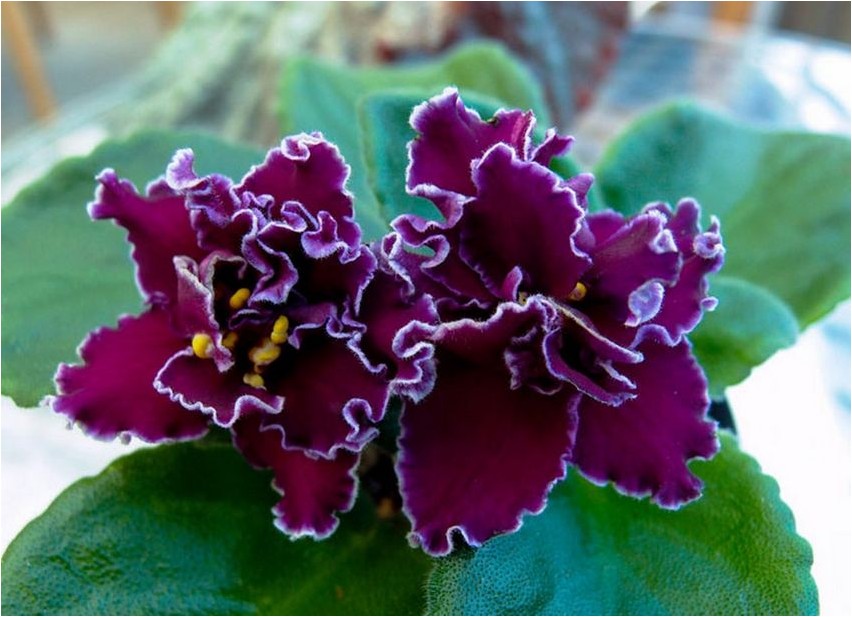
The African violet has long been associated around the world with motherhood. Therefore, if you are at a loss with a gift for your mother, feel free to buy a compact pot with a delicate noble plant.
This is exactly the plant you have been looking for for so long!
The best violets of Odessa. Exhibition of violets. Violet world. Exotic violets. New delivery.