Chives
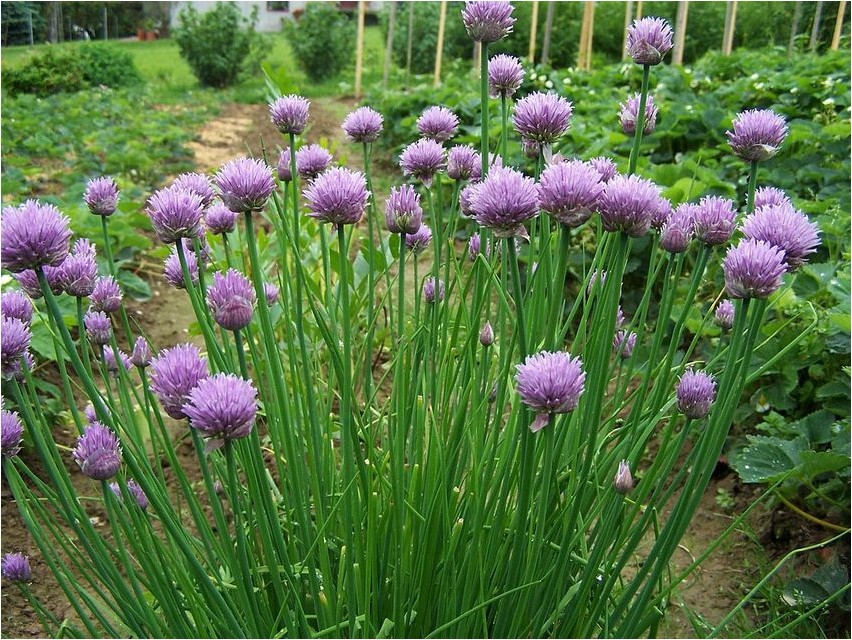
Chives (lat. Allium schoenoprasum) are represented by perennial herbaceous plants of the Onion family. It is often called — short onion, chives, sibulet onion.
In nature, chives grow in a temperate climate zone. Typical locations are wet meadows and river valleys. Currently cultivated in India, USA, China, European countries and Russia.
Description
Chives are herbaceous plants that form oblong ovoid or conical bulbs that do not exceed 10 mm in diameter. The bulbs of the culture in question are equipped with leathery fibrous shells that feel like paper to the touch. As a rule, the shells have a brownish color. The stem of chives is thickened, depending on the variety it can be smooth or slightly rough, it is partially covered with leaf sheaths, and reaches a height of 50-70 cm. The foliage of the crop is semi-cylindrical, fist-shaped, and is lower in length than the stem.
The flowers are small, collected in spherical or bunch-shaped capitate umbrellas. The perianth is shiny, can have a pinkish (very light) or pale pinkish-violet color, it consists of lanceolate or linear-lanceolate slightly extended pointed or blunt petals. The fruits are capsules. Flowering of chives is observed in the second ten days of May — the second ten days of August. The crop begins to bear fruit in June — July.
Features of cultivation
Chives are a light-loving plant, but they also feel good in openwork shade. In the second case, plant leaves remain juicy for a long time. Chives are undemanding to soil fertility, although they develop best in moist, light, non-saline and mineral-rich soils that are not clogged with weeds. The best predecessors of the crop in question are considered to be Solanaceae and Cabbage, as well as herbs and cereals. Chives can be useful for carrots; they can be planted along the beds; their smell will repel insects.
Subtleties of reproduction
Chives are propagated by seed and vegetatively. You can get seeds from plants, but not in large quantities, especially when you compare it with other representatives of the Onion family. Self-seeding is also present. Sowing of seeds is carried out in the first ten days of May or a second time — in the first ten days of July. Before sowing the seeds, they are soaked in warm water for a day, then slightly dried, then sown in the prepared soil in rows or nests (3-4 seeds per nest), leaving a distance between rows of 25-30 cm.

Autumn sowing of chives under cover in the form of sawdust or dry leaves is not prohibited. In this case, you can do without soaking. The furrows for autumn sowing are prepared in advance. The seeding depth is 2 cm. Chives are characterized by increased cold resistance, although the seedlings do not tolerate sudden day and night temperature changes.
Vegetative propagation of the crop involves dividing the onion into several parts, each division should contain up to 8 onions. The cuttings are planted in rows with a distance of at least 30 cm. Immediately after planting the cuttings, abundant watering is carried out. It is advisable to carry out this procedure in early spring or late summer.
Care
Caring for chives is simple, it consists of weeding and loosening the rows as necessary, fertilizing and moderate watering, avoiding drying out. Thinning is permissible if the crops are too dense, otherwise the appearance of various diseases and pests cannot be avoided. Loosening is carried out three times a season, and it is best to do this after watering or precipitation.
The first two years of weeding are a vital procedure; later the chives grow and form dense turf. The crop is fed in mid-summer; complex mineral fertilizers and organic matter can be used for these purposes. It is not forbidden to use manure diluted with water as fertilizing, to which potassium-phosphorus additives can be added.