Salak
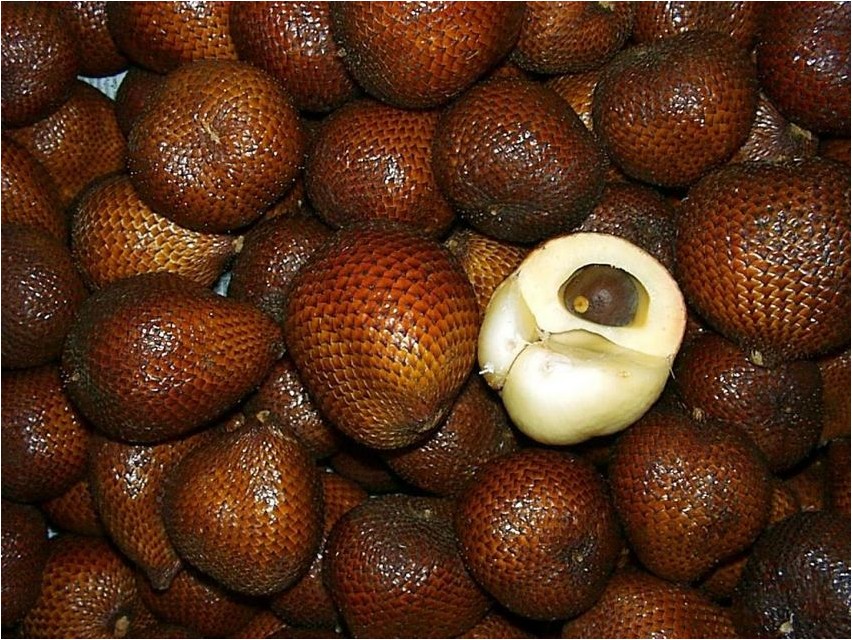
Salak (lat. Salacca zalacca) is a fruit tree plant belonging to the Palm family.
Description
Salak is a fast-growing palm tree, endowed with a short, gnarled trunk and growing up to two meters in height. The length of its feathery leaves can reach from three to seven meters, and on the leaf petioles you can see blackish, rather long spines that are clearly visible to the eye. The leaves are whitish on the undersides, and glossy and green on top.
Since herring is a dioecious plant, its inflorescences can be female or male. Distinguished by their club-shaped form, male inflorescences can reach a length of more than a meter, while female inflorescences are usually much shorter — as a rule, their length does not exceed thirty centimeters.
The rough herring fruits, tapering wedge-shaped towards the base, can have either a pear-shaped or an oval shape. In most cases, they reach a diameter of three to four centimeters, and their average weight is fifty to one hundred grams. By the way, clusters of herring grow at the very base of the trunks, right above the ground. All fruits are covered with a brownish scaly skin, which is not difficult to remove. Such an unusual skin is very reminiscent of snake skin, which is why the herring is also nicknamed “snake fruit”. The pulp of these fruits is usually beige and formed by one or several segments. The taste of herring is refreshing and very pleasant, somewhat reminiscent of banana and pineapple and having a slight nutty flavor. But unripe fruits are very astringent, as they contain quite a lot of tannins. Inside each fruit you can find inedible oval brownish seeds in quantities of one to three pieces. As a rule, herring begins to bear fruit only from the fourth year, and it takes about six months for its fruits to ripen.
Herring is often confused with the fruit rakam, in the belief that “rakam” is the Thai name for herring. In fact, these are completely different fruits. Crayfish are distinguished from herring by a more concentrated taste and reddish color.
Where does it grow
Mainly herring grows in Southeast Asia. Moreover, in Indonesia, the season of this fruit is celebrated throughout the year, and in Malaysia and Thailand it occurs from June to August.

It is generally accepted that the most delicious herring grows in Java near Yogyakarta, as well as in Bali. And some amateurs manage to grow this unusual crop at home from an ordinary seed.
Application
The fruits of herring are eaten raw or prepared into salads and compotes. And unripe fruits lend themselves well to pickling.
In order to clean the herring, you need to carefully tear or cut its scaly skin at the very edge, and then remove it in the same way as removing the shell from eggs.
Tannin, contained in herring and giving these unusual fruits a peculiar astringent taste, helps remove a wide variety of harmful substances from the body and has antihemorrhoidal, antidiarrheal and hemostatic properties.
Hazardous properties
When trying herring for the first time, you should not immediately eat too much of it — excessive zeal can lead to allergic manifestations such as rash or itching, as well as provoke digestive system disorders. And to avoid diarrhea, you should purchase only fresh fruits.
How to choose good fruits?
When choosing herring, it is best to give preference to larger round fruits, since the smaller the herring, the more sour it is. And if it is colored pinkish-purple, this indicates that the fruit is too sour. Brownish fruits have the best taste. Moreover, the darker the color, the sweeter and more aromatic the herring will be. And all fruits should be quite firm to the touch — their softness indicates that the fruits have either begun to deteriorate or are overripe.





