Sequoiadendron
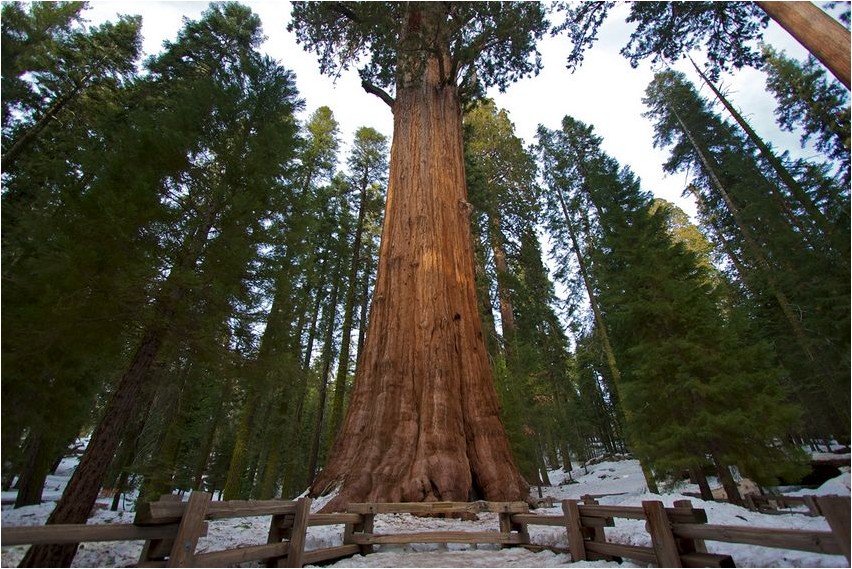
Sequoiadendron (lat. Sequoiadendron) is a genus of trees in the Cypress family; previously the genus was classified as a member of the Taxodiaceae family. The genus includes only one species — the giant Sequoiadendron, or Mammoth tree (lat. Sequoiadendron giganteum).
The plant was originally called Wellingtonia in honor of the English Duke of Wellington, but was later renamed Sequoiadendron. Today, majestic trees can be found in many European countries, including Germany, Holland, Switzerland, Poland, etc. In Russia, sequoiadendron is rare, mainly on the Black Sea coast.
Characteristics of culture
Sequoiadendron is a tall, powerful tree up to 100 m high with a trunk reaching 7-12 m in diameter. Today, representatives of the genus are considered the largest plants on Earth. Age varies from 3000 to 3500 years. Some scientists claim that plants can develop normally for up to 6, 000 years.
Sequoiadendron has a beautiful dark green pyramidal crown that forms near the surface of the soil. The bark of the trunk and old branches is reddish in color, the needles are scaly, the cones are single, covered with flat shield-shaped scales arranged in a spiral. Over time, the crown of trees loses its correct shape, and the trunk becomes bare and increases in size.
Sequoiadendron wood has a light red heartwood, medium hardness and good mechanical properties. The resins and oils found in plants prevent rotting, as well as the attack of insects, including termites. Wood is ideal for construction work of various types. Previously, tiles, fences, and fruit storage containers were made from it. Currently, sequoiadendron is protected because it is an endangered species. And now it is practically not used for economic purposes.
The largest trees today have their own names, for example, “Giant Grizzly” (height 65 m, trunk diameter 9 m, age 2700 years), “Father of Forests”, “General Grant”, “General Sherman”. Surprisingly, up to 50 people can fit on the cutting of one tree, recognized as a protected area. In some countries, sequoiadendrons grow, in the lower part of the trunks of which tunnels are made, through which cars can move freely. Another equally important fact is that the cultivated wood boasts fire resistance; they can survive even severe fires, but black “scars” remain on the trunks.

Subtleties of cultivation and reproduction
Despite being highly ornamental, sequoiadendrons are rarely used in landscape design. Therefore, proper growing and care practices for these plants have yet to be developed. When cultivating sequoiadendrons, the cultivation techniques used for conifers should be followed, as they are the closest. Sequoiadendrons are heat- and moisture-loving. The optimal summer temperature is 25-29°C. They prefer well-drained, moderately moist soils, such as sandy, loamy, granite residual, or alluvial soils with a pH of 5. 5-7. 5.
Sequoiadendrons are propagated by seeds and cuttings. The former method is the most effective and popular among gardeners. Sowing is done in April-May. The seeds don”t require any pre-treatment, but soaking them in warm water for 24-48 hours is acceptable (this will increase soil germination by up to 2%). By September-October, the seedlings reach a height of up to 10 cm.
Planting is done in the spring. Planting holes, as for all conifers, are prepared at least 2-3 weeks in advance. Heavy soils require drainage. Pebbles, broken brick, or gravel can be used for drainage. The drainage layer should be at least 20 cm thick. After placing the seedling in the hole, the voids are filled with a mixture of leaf mold, turf, sand, and clay. The addition of mineral and organic fertilizers is encouraged.
The root collar is positioned at the soil surface. After planting, water thoroughly. Subsequent care consists of regular watering, loosening the soil around the tree trunk, and preventative treatments against pests and diseases. Young plants require winter protection, as they are often damaged by frost.


