Common Dubrovnik
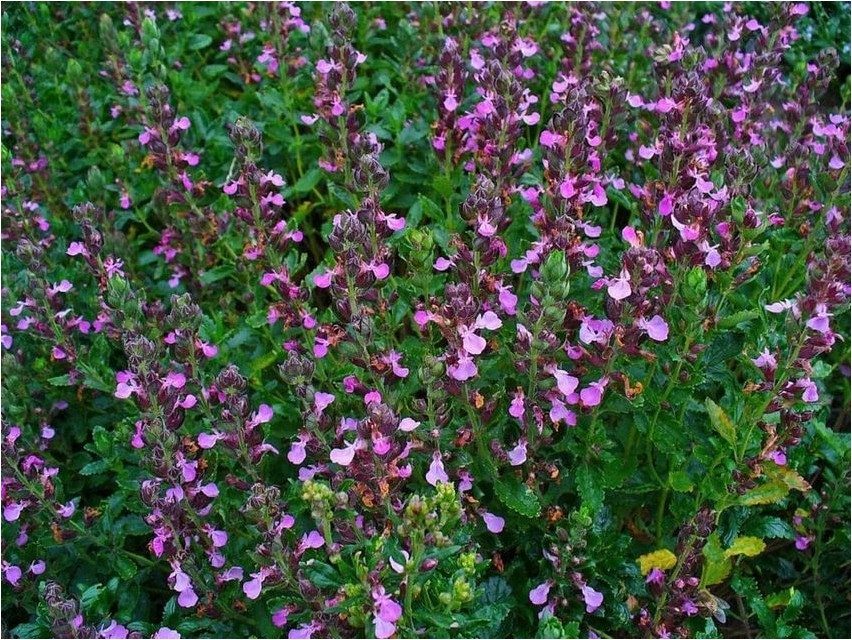
Common Dubrovnik is one of the plants of the family called Lamiaceae; in Latin the name of this plant would be Teucrium chamaedrys.
As for the name of the common oakberry family itself, in Latin it will be like this: Lamiaceae Lindl.
Description of common Dubrovnik
Common Dubrovnik is a perennial herbaceous plant whose height will vary between ten and forty-five centimeters. Common Dubrovnik is covered with protruding hairs. The stem of this plant will be woody at the very base, it is endowed with curved or twisting rising shoots, which can be colored in either reddish or pale green tones. The length of the leaves will be about one to four centimeters, they will be ovoid, oblong or oval in shape. The leaves of the common dubrovnik are endowed with a wedge-shaped base and are large-shaped. The bracts of this plant are most often colored green, but sometimes they can be purple. The flowers are quite small in size, they are two-lipped and purple in color. Such Dubrovnik flowers are collected in racemose inflorescences. The teeth of the calyx are almost identical; along the very edge they are lined with thick and short hairs, which contain an admixture of long cilia. The length of the purple corolla varies between ten and thirteen millimeters.
Common Dubrovnik blooms in the summer. Under natural conditions, this plant can be found on the territory of the European part of Russia in the Volga-Don and Black Sea regions, as well as in the Carpathians and the Dnieper region of Ukraine, the Caucasus and Moldova. For growth, common Dubrovnik prefers forests, steppes, rocks, rocky slopes and screes in the lower mountain zone. It should be noted that this plant is not only decorative, but also a rather valuable honey plant.
Description of the medicinal properties of common Dubrovnik
Common Dubrovnik is endowed with quite valuable healing properties, and it is recommended to use the flowers, leaves and stems of this plant for medicinal purposes. The presence of such valuable healing properties is explained by the plant’s content of essential oil, stachyose, iridoids, stigmasterol, alkaloids, dieterpenoids, choline, vitamin C, flavonoids, tannins, beta-sitosterol, as well as phenolcarboxylic acids and their derivatives. It is noteworthy that the seeds of the common dubrovnik contain fatty oil.
Infusions, as well as decoctions of the herb of this plant, are endowed with antifever, astringent and hemostatic effects. As for traditional medicine, an infusion of the common Dubrovnik herb is used for gastric hyposecretion, gastralgia, dysentery, diarrhea, gout, hemoptysis and rheumatism, as well as as a diuretic and an appetite enhancer. A decoction of the herb of this plant is used for flatulence, anemia and chronic respiratory diseases, as well as as a diaphoretic and mild laxative. Infusion and decoction of the herb are recommended for use as a tonic and aromatic agent, as well as a remedy that can improve digestion during stomach colic. Dubrovnik herb powder is used for hypertrophy of the spleen, and externally this remedy is used for eye diseases, rheumatism, purulent wounds, leucorrhoea, hemorrhoids and furunculosis. The alcoholic extract of the herb of this plant is endowed with a lactogenic effect and is capable of exhibiting antibacterial activity.





