Miricaria bractae
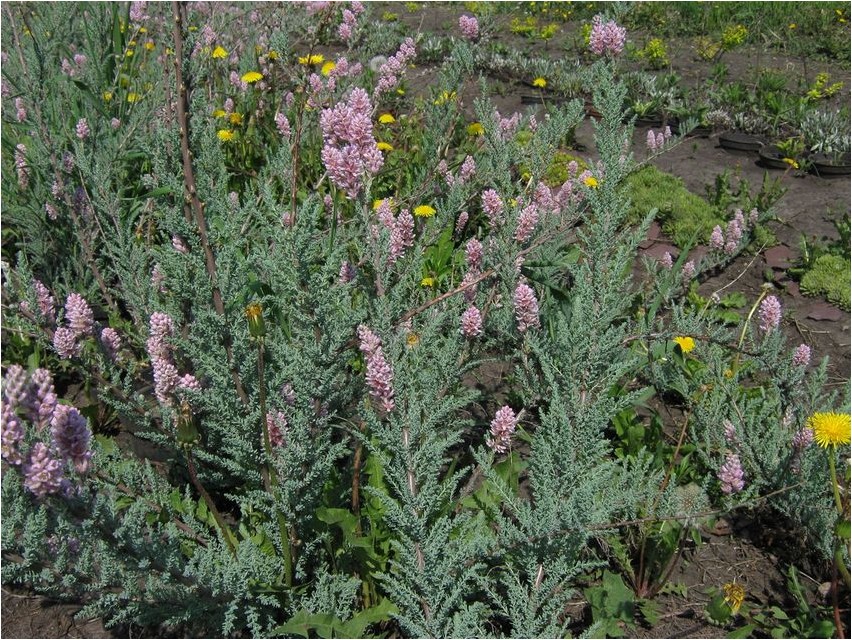
Myricaria bractae is one of the plants of the family called cabbage or cruciferous plants; in Latin the name of this plant will be as follows: Myricaria bracheata Royle (M. alopecuroides Schrenk, M. herbaceae Ledeb.).
As for the name of the family of the Myricaria bracts plant, in Latin it will be like this: Brassicaceae Burnett. (Cruciferae Juss.).
Description of Myricaria bractae
Miricaria bract is a shrub endowed with yellowish-gray or brownish-gray bark. The length of such a bush will fluctuate between one and two meters. The leaves of Myricaria bractae are quite small in size, their diameter is about one to six millimeters, and the width does not exceed one millimeter. Such leaves can be either linear-lanceolate or linear, and are also sessile. The brushes of Myricaria pritsnivetkova will be quite sparse, apical and lateral, they are thick, elongated and almost spicate. The length of such brushes will be about five to eighteen centimeters, and the width is approximately one to one and a half centimeters. The petals of this plant are oblong-elliptical, they are colored pink, their length is five to seven millimeters, and their width is about two and a half to three and a half millimeters. The seeds of Myricaria bractae are quite small in size, they are oblong in shape, and their length is about one and a half millimeters.
This plant blooms from May to August. Under natural conditions, Myricaria bractae is found in Central Asia, as well as the Altai region of Western Siberia. For growth, this plant prefers sandbanks and pebbles in river valleys, mountain slopes, gorges, drying up beds of mountain rivers and streams. It is noteworthy that this plant can be found either singly or in groups.
Description of the medicinal properties of Myricaria bractae
Miricaria bract is endowed with very valuable healing properties, and it is recommended to use young green branches of this plant for medicinal purposes.
The presence of such valuable healing properties should be explained by the content of alkaloids, tannins, alkaloids, beta-sitosterol, ellagic acid, phenolcarboxylic acids, alcohols, vitamin C, higher aliphatic hydrocarbons in this plant, as well as the following flavonoids: rhamnazin, rhamnetin, quercetin, kaempferide, tamarixetin, isoquercetin and glycoside Tamarixetine.

As for traditional medicine, remedies based on this plant are quite widespread. It is recommended to use a decoction prepared from young twigs and leaves of Myricaria bractae for rheumatism, while a decoction based on green twigs of this plant is effective for various gynecological diseases. It is noteworthy that the leaves of Myricaria bractae are recommended to be used as a tea substitute.
The branches of this plant can be used for weaving, and the stems are used for making mouthpieces. It should be noted that the bark of Myricaria bractae is a source for obtaining black dye.
For inflammation of the uterine appendages, it is recommended to use the following very effective remedy based on this plant: to prepare such a remedy, take two tablespoons of crushed dry green twigs per half liter of water. The resulting mixture should be boiled for six minutes, then left to steep for two hours and strain thoroughly. Take the resulting remedy three times a day, half a glass.





