Pear
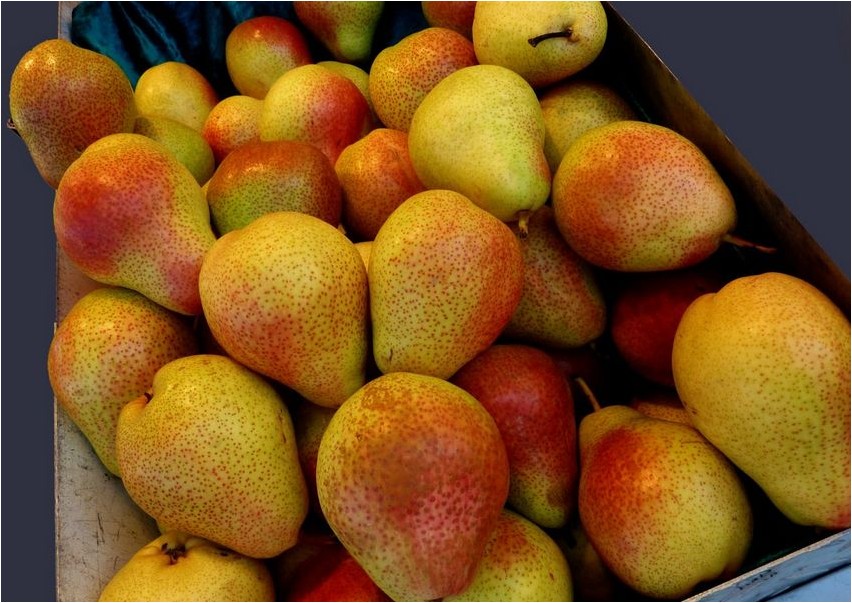
Pear (Pyrus) is a fruit crop; a genus of trees belonging to the Rosaceae family.
Description
The pear is represented by a tree with a pyramidal or rounded crown, prone to thickening. Under favorable growing conditions it can reach quite large sizes — 20-25 m in height and up to 5 m in crown diameter. The main trunk and young shoots of the pear are smooth, with dark gray, light red bark; over time, cracks form on the bark; they can be both transverse and longitudinal. The bark of some species is folded outward.
The leaves of the plant are wide, ovoid, slightly pointed, green, from 2. 5 to 12 cm long, and can be serrated or entire. The underside of the leaves is pubescent, bluish-green. The flowers, located on pedicels, consist of corymbose inflorescences and do not exceed five centimeters in length. The flowers have a white or pink corolla
The fruits are in the form of false drupes, spherical or ovoid, depending on the type and variety, with green, yellow, light yellow or red skin. Pear seeds are brown and reddish-brown, round or oval in shape, tapering to the tip. The flowering of the crop lasts about two weeks, and can occur in the third ten days of April — the first ten days of May. The fruits appear no earlier than three years after the seedling is planted in the ground.
Popular types
*Common pear — represented by rather tall trees, the trunk and branches of which are covered with brown-yellow bark. The leaves of the plants are dark green, smooth, about 6-7 cm long. The flowers are white, collected in corymbs. The fruits are spherical, slightly flattened, yellow in color, have a fairly tart taste, and up to five centimeters in diameter. Flowering of the common pear is observed in mid-May, the fruits enter the ripe phase in the first ten days of September.
*Ussuri pear — represented by trees reaching a height of 10-12 m. The branches bear round, purple-green foliage. The flowers are collected in corymbs, white. The fruits are egg-shaped, greenish-red in color, very juicy. The Ussuri pear blooms in mid-May.

*Pumpy pear — represented by small trees no more than five meters high. The leaves are oval, wide, 4-8 cm long, entire, with a serrated edge, pubescent on both sides. The flowers are small, collected in corymbs, regular in shape, white with a pinkish tint. The fruits are round, yellow-green. Flowering occurs in mid-May, fruits ripen in October-November.
* Willow pear — represented by low trees up to three meters high. It has spiky branches of an ash color. The leaves are narrow-lanceolate, entire-edged, silvery or gray, 3-9 cm long. The flowers are small, white, collected in corymbs. Fruits are ovoid or spherical, golden or yellow in color with speckles
Landing
For growing pears, sunny areas with loose soil that can allow sufficient moisture and air to pass through for normal growth and development of pears are preferred. It is best to plant pear seedlings in the fall, although it is also possible in the spring. The holes for planting are prepared in a couple of weeks; the optimal planting period is the third ten days of September — early October. The diameter of the pit should be about 150 cm, the depth should be about 90-100 cm.
The top layer of soil, taken out of the pit, is mixed with mineral fertilizers (phosphorus, nitrogen and potassium) and organic matter (peat or rotted manure) and wood ash. Fresh manure is not suitable for these purposes, as it can damage the roots. At the bottom of the pit, a hill is formed from part of the prepared mixture; on strongly acidic soils, liming is first carried out, after which the seedling is lowered, evenly distributing the roots over the hill. The voids are filled with the second part of the soil mixture and compacted thoroughly. The root collar of a pear seedling is not buried. Immediately after planting the seedling, watering (20 liters of water per plant), mulching and tying the seedlings to stakes is carried out.
Care
Caring for the culture does not cause any particular difficulties. It consists of systematic watering, loosening the tree trunk area, removing weeds, pruning and controlling pests and diseases. Young trees require more careful care, especially in winter. The best system for watering the crop is sprinkling, although a 15 cm wide groove near the tree trunk, into which water is carefully poured, is also acceptable. Watering is carried out twice a month, more often in dry weather. Watering rate is 30 liters per 1 sq. m area of the trunk circle. Immediately after the spill, loosening is carried out; this procedure allows the soil to be saturated with oxygen, which has a beneficial effect on the roots of plants and their health in general.
It is recommended to apply fertilizers only in the second year after planting. Fertilizing with organic fertilizers is carried out once every three years, and with mineral fertilizers — every year. For 1 sq. m of tree trunk area, on average, about 9-10 kg of humus, 25-30 g of potassium chloride and 15-20 g of urea are consumed.
Formative and sanitary pruning of the pear crown is also necessary to obtain high fruit yields. In the tenth year after planting the crop, excess skeletal branches are cut off, and semi-skeletal branches are shortened. The plant is formed every year in early spring before sap flow. Sanitary pruning is also carried out; it involves the removal of old and broken branches.
https://www. youtube. com/watch? v=Riu0QV2pyVE





