Onosma zauralensis
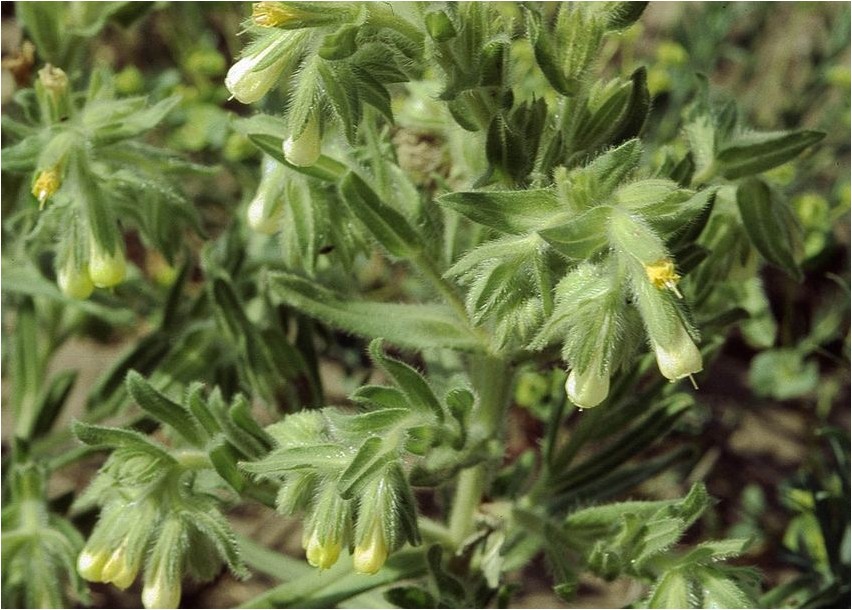
Onosma transrhymmense Klok ex M. Pop.
As for the name of the Trans-Ural Onosma family itself, in Latin it will be: Boraginaceae Juss.
Description of Trans-Ural onosma
Onosma transuralis is a biennial herbaceous plant, the height of which will fluctuate between thirty and forty centimeters. The stems of this plant can be from one to five, they will be less thick and weaker than those of other types of onosma. At the top, such stems are paniculate-branched, and when fruiting they will be splayed-branched, such stems are painted in whitish-green tones, while the stems will also be protruding-bristly. It should be noted that by the time of flowering, the basal rosettes of Onosma Transural will die off. The stem leaves of this plant will be linear-ribbon-shaped and quite numerous, their length will be about three to five centimeters, and the width will be identical. The curls of Onosma Transural are not very thick and small, the length of the corolla will be about fifteen to seventeen millimeters, on the outside such a corolla will be bare or rarely fluffy, and later it becomes open and brown. The length of the nuts of Onosma Transurals will be about three to four millimeters, they will gradually taper into a spout and such nuts are colored in dark gray tones.
This plant blooms from May to June. Under natural conditions, this plant is found in Central Asia, the Angara-Sayan region of Eastern Siberia, the Irtysh and Upper Tobolsk regions of Western Siberia, as well as in the European part of Russia. For its growth, Onosma Transural prefers fallow lands, steppes and rocky slopes.
Description of the medicinal properties of Onosma Transural
Onosma Trans-Ural is endowed with very valuable healing properties, and it is recommended to use the herb of this plant for medicinal purposes. The term grass includes leaves, flowers and stems.
Onosma transuralensis has hypotensive, sedative, and diuretic properties. It is noteworthy that experiments have shown that an infusion prepared from this plant’s herb has a myotropic effect. Furthermore, such an infusion significantly reduces capillary fragility and vascular permeability, and also increases diuresis and has a pronounced sedative effect.

For hypertension, to increase diuresis, and for headaches, the following highly effective remedy based on this plant is recommended: to prepare this remedy, take three tablespoons of dry, crushed onosma transuralensis per 400 milliliters of water. The resulting mixture should be boiled for approximately three to four minutes over fairly low heat, then left to steep for approximately two hours and then strained very carefully. Take one-quarter cup of the resulting medicinal remedy made from Transural Onosma three times daily before meals.
For insomnia, headaches, and hypertension, this remedy is recommended: to prepare it, take one tablespoon of the herb, two tablespoons of motherwort, and one tablespoon of sweet clover per cup of boiling water. Let this mixture steep for three hours and strain. Take one-third cup of this remedy twice daily before meals.