Anguria
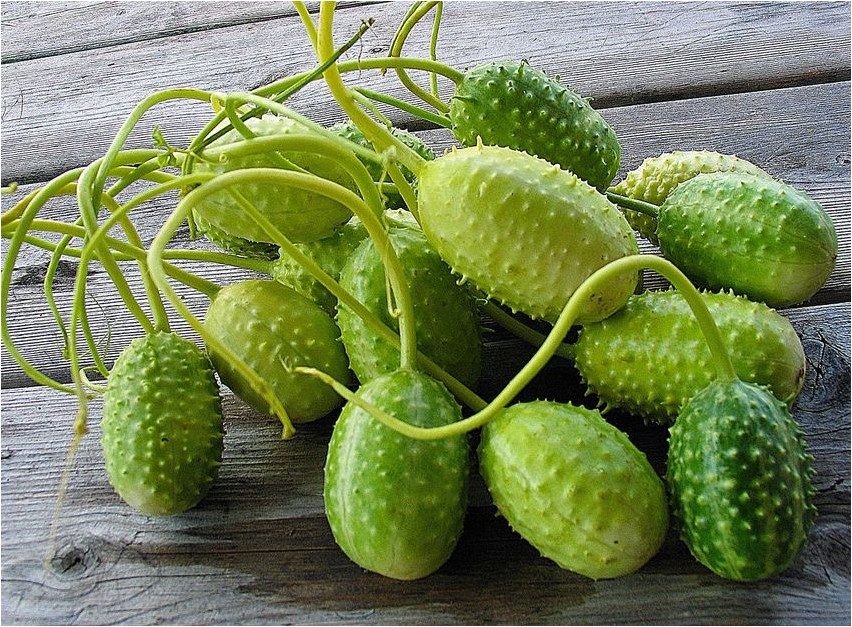
Anguria (lat. Cucumis anguria) is a representative of the genus Cucumber of the Pumpkin family. Other names are Antillean cucumber or horned cucumber. Grows in subtropical and tropical regions of South and North America.
Characteristics of culture
Anguria is an annual liana-like crop that during its growth forms long creeping stems, pubescent over the entire surface. The leaves are figured-carved, harsh, equipped with numerous tendrils. The fruit is small, cylindrical in shape, covered with thorns, reaches 3-4 cm in diameter. The average weight of the fruit is 30-50 g. In terms of taste, anguria resembles ordinary cucumbers. Unripe fruits are green in color, while ripe ones are yellowish-orange. Only young fruits are eaten; at a later age, anguria is not edible. Cultivated species of Anguria are grown as a vegetable or ornamental plant.
Growing conditions
Anguria produces good fruit yields when grown on aerated, moderately moist and humus-rich soils. Increased air humidity is also welcome. This factor is due to the fact that the leaves of the plant have a high evaporative capacity and a root system located close to the soil surface. The optimal temperature for the growth and development of the Antillean cucumber is 25-30C.
When the crop is kept in favorable conditions, it is rarely affected by pests and diseases. The best predecessors of anguria are tomatoes, onions, carrots, grains and legumes. It is not recommended to grow the crop after representatives of the Pumpkin family. Anguria has a negative attitude towards winds, so it is advisable to plant corn, Jerusalem artichoke or sunflower on the north side. Plants cannot tolerate frost, especially when they are young.
Sowing seedlings and planting in the ground
Anguria is grown mainly by seedlings, primarily in the regions of central Russia. Seeds are sown in seedling containers or separate pots 25-30 days before the intended transplant into open ground, i. e. in mid or late April. The bottom of the seedling container is covered with small pebbles, and then a layer of fertile soil is laid. The soil must be spilled with a weak solution of potassium permanganate (for disinfection).
Before sowing, seeds are soaked for 15-20 minutes in a weak solution of potassium permanganate, then washed with warm water and wrapped in damp gauze or a rag. Anguria seeds are sown horizontally. Planting depth is 1. 5-2 cm. The crops are watered abundantly, covered with film and placed in a warm room. The film cover is systematically removed to ventilate the crops. With the appearance of entrances, seedling boxes are transferred to well-lit window sills with shading from direct sunlight.

A week after sowing, fertilizing is carried out with a solution of microelements, after 8-12 days — with mineral fertilizers. When lashes form on the seedlings, pinching is carried out. This procedure will contribute to the formation of side shoots. Before planting seedlings in the ground, they need support, which can be twigs. Before planting, the seedlings are watered abundantly and transferred into the hole along with a lump of earth, being careful not to damage the root system.
At first, the plants are shaded from direct sunlight. To obtain a stable harvest, anguria is planted at intervals of 5-10 days, because initially only male flowers are formed on the plants. The distance between rows should be at least 50-60 cm, between plants — 70-80 cm. It is important for Anguria to provide reliable support on which the plant will climb.
Care
Antillean cucumber needs systematic watering, especially during the fruiting period. Regular fertilizing with mineral fertilizers and liquid solutions of microelements is no less important. Weeding and loosening of rows is mandatory. The fruits are removed constantly, thus the process of formation of new ones can be accelerated.