Deytsia
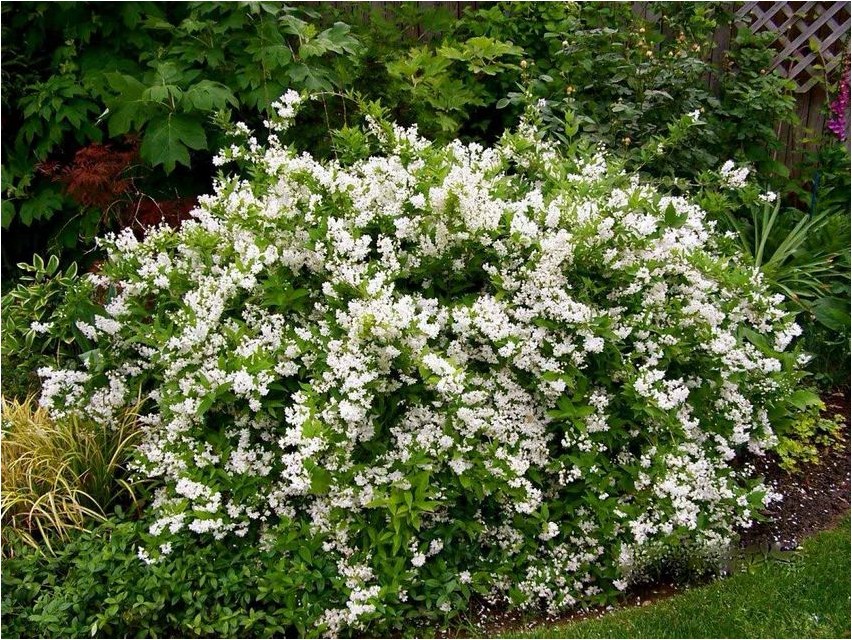
Deutzia (lat. Deutzia) refers to ornamental crops; This is a fairly large genus of beautifully flowering deciduous shrubs belonging to the Hydrangeaceae family. The birthplace of action is Asia.
Popular types and their descriptions
*Deutzia scabra (lat. Deutzia scabra) — characterized by beautifully flowering deciduous shrubs, reaching a height of up to 250 cm, with a vertical crown. The bark comes off in layers, gray-brown, sometimes with a red tint. The foliage can be ovoid or lanceolate, harsh to the touch, pubescent, pale green in color, becoming yellowish, golden and bronze in the fall. Flowers, depending on the variety, can be snow-white, lilac or bright pink, collected in brushes or panicles, without a distinct aroma. Flowering is bright and abundant, occurring in the third ten days of July — the first ten days of August.
*Amur deutzia, or small-flowered (lat. Deutzia amurensis) — characterized by shrubs up to 2 m high with a spreading crown. The bark is brownish, later becoming gray. The leaves are elliptical in shape, pubescent over the entire surface, serrated along the edges, sharp at the tips. There are many flowers, white, collected in corymbs.
*Deutzia elegantissima (lat. Deutzia elegantissima) — characterized by shrubs whose height does not exceed 1 m. The branches bear large, dark green foliage, sharp at the ends. The flowers are snow-white on the inside, pinkish on the outside, collected in multi-flowered racemes.
*Deutzia gracilis (lat. Deutzia gracilis) — represented by graceful shrubs up to 150 cm high, equipped with thin branches bearing green lanceolate foliage, pointed at the ends. The flowers can be snow-white, collected in racemes or panicles. Flowering begins in the first or second decade of June.
Features of cultivation
Deytsia is a photophilous crop, prefers well-lit areas. Blooms poorly in shade. It does not have any special requirements for soil, although it grows better in light, well-drained, nutritious and moist soils. Most varieties of deutia are not winter-hardy; in harsh and snowless winters, young shoots freeze. At temperatures belo w-30C, deutia freezes completely and dies (some species are not able to withstand frosts belo w-25C). The crop does not respond well to cold northern winds, so it is recommended to plant it on gentle southwestern slopes.

Features of propagation and planting
Deutzia propagates by seeds, layering, summer and winter cuttings, and root suckers. The seeds are sown without pre-treatment in early spring, spreading them over the soil surface without burying them. The seedlings are watered occasionally, and when the seedlings develop three leaves, they are planted in open ground.
Russian gardeners most often grow deutzia by propagating them from cuttings or by planting seedlings purchased from a nursery. Cuttings are taken from the second ten days of June to the first ten days of July. They are then planted at an angle in a nutrient-rich mixture of peat and humus for rooting.
Plants obtained by cuttings are transplanted to their permanent locations after two years. For the winter, young plants are insulated with spruce branches. Planting holes are prepared three weeks in advance, after which they are filled a third of the way with a nutrient-rich mixture. Liming is required in acidic soils. The optimal distance between shrubs is 200-250 cm.
Care
Deutzia is a moisture-loving plant and does not tolerate dry periods well. It requires regular watering, usually 2-4 times every 30-40 days, with 15-20 liters per plant. Monthly feeding with slurry and phosphorus fertilizers is recommended, along with careful loosening and weed removal. Young shrubs require mulch.
Immediately after flowering, deutzia should be pruned (both sanitary and formative). Formative pruning involves removing broken and dried branches and thinning. Formative pruning aims to give the deutzia a beautiful crown shape. Three-year-old branches are pruned, leaving small stumps up to 10 cm long. For the winter, the plants are covered with spruce branches, and the lower leaves are bent to the ground and earthed up.
Applications
Deutzia are widely used in single and group plantings, as specimens and free-growing hedges. Low-growing varieties of deutzia are used to create borders and rock gardens, as well as in rock gardens.





