Sedum telephium L.
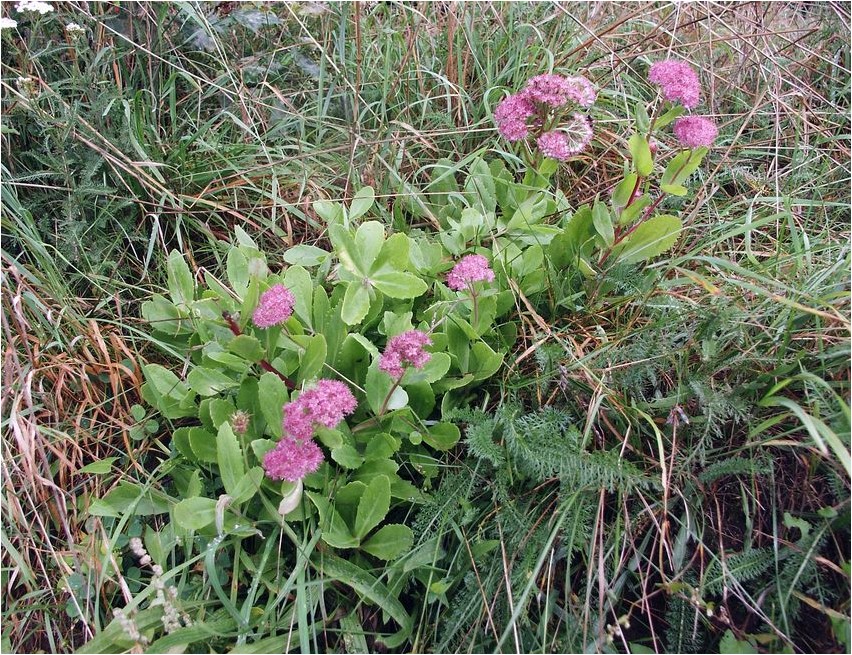
Sedum telephium L. is a member of the Crassulaceae family. Its Latin name is Sedum telephium L.
The family name itself is Crassulaceae DC.
Description of Sedum
Sedum telephium, commonly known as hare’s cabbage, is a perennial herbaceous plant that grows between twenty and sixty centimeters tall. This plant has tuberous roots and erect, solitary stems. The leaves are sessile, alternate, ovate-oblong, serrated along the edges, and approximately twenty to seventy millimeters long. The flowers are pentamerous and form a dense inflorescence. The sepals of the common sedum are about two and a half centimeters long, green in color, and fused at the base. Remarkably, the petals of this plant are two to three times longer than the calyx and can range in color from crimson to red. This plant has only ten stamens and five pistils, fused at the base, each with a short, curved beak.
Sedum blooms in summer. In the wild, this plant is found in the Aral-Caspian region of Central Asia, the Arctic, European Russia, and Western and Eastern Siberia. It prefers river floodplains, forest clearings, pine forests, croplands, meadows, shrubby areas, and sandy, dry, and alkaline soils. It’s worth noting that sedum vulgare is not only a highly ornamental plant, but also a honey plant and perganic plant.
Description of the medicinal properties of sedum vulgare
Sedum vulgare has very valuable medicinal properties, and it is recommended to use the herb and juice of this plant for medicinal purposes. The term “herb” includes the leaves, flowers, and stems.
The presence of such valuable healing properties is recommended to be explained by the content of carbohydrates, sucrose, glucose, fructose, alkaloids, sedoheptulose, phenols, triterpene saponins, tannins and arbutin in the underground part of the plant. The aerial part of this plant contains essential oil, tannins, coumarins, phenols, arbutin, phenolcarboxylic acid, anthraquinones, organic acids succinic, glycolic, fumaric, malic and oxalic.

It should be noted that this plant is a very valuable source of tissue preparations, which are called biogenic stimulants; in fact, in terms of biological activity, such preparations will exceed preparations based on aloe. An infusion and decoction prepared from the sedum herb should be used for metabolic disorders, arrhythmias, menorrhagia, infertility, osteoalgia, tachycardia, chronic rheumatism and arthalgia.
The fresh juice of this plant or its decoction is a very valuable wound-healing and hemostatic agent. Sedum juice and extract have the ability to stimulate the central nervous system. Infusion and decoction prepared from this plant will have antibacterial activity. An infusion based on the tuberous roots of this plant should be taken for epilepsy and impotence, and externally this remedy is used as a wound-healing agent for warts, calluses and burns.





