Sweet Potato
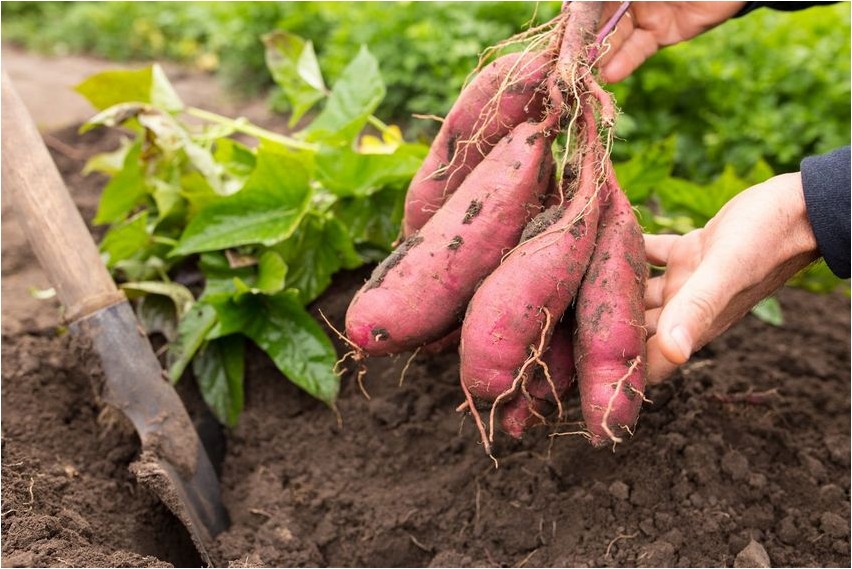
Sweet potato (lat. Ipomoea batatas) is considered one of the most valuable feed and food crops; This is a tuber-bearing plant belonging to the Convolvulaceae family. It is often called sweet potato.
South America is considered to be the birthplace of sweet potatoes. Today the plant is actively cultivated in the tropics and subtropics, less often in areas with temperate climates. Sweet potatoes are widely cultivated in India, North Africa, China, America and some European countries. In Russia, the plant is cultivated in the southern regions.
Description
Sweet potatoes are represented by herbaceous vines with creeping stems that reach a length of up to 5 m. The height of sweet potato bushes is up to 15-18 m. The lateral roots of the plant are very thick, and during growth they form spindle-shaped, round or oval tubers. The flesh of sweet potatoes is yellowish, light orange, white-cream, pinkish, purple, and sometimes red. The tubers themselves are smooth, less often rough to the touch. There are no eyes on the tubers; sprouts are formed from hidden buds. On average, one tuber weighs 1-2 kg.
Sweet potato foliage is green or green-violet in color, located on elongated petioles. Flowers can be solitary or collected several times in loose inflorescences, sitting in the axils of the leaves. The corolla is quite large, funnel-shaped. Some forms of sweet potato do not enter the flowering phase. In regions with a temperate climate, plant flowering is practically not observed. The fruits are presented in tetrahedral spherical boxes. The seeds are brownish and do not exceed 5 mm in diameter.
Location
Sweet potatoes are classified as light-loving plants; plants do not form tubers in the shade. The optimal temperature for growth and development is 24-25C. Soils for cultivating sweet potatoes should be light, loose, permeable, neutral; sandy and humus substrates are ideal. The crop is resistant to lack of moisture. Clayey, waterlogged, saline soils are not suitable for cultivation. The best predecessors are zucchini, tomatoes and cucumbers.
Features of cultivation
The crop in question reproduces by root tubers and tuber sprouts. Root nodules can be planted, however, in this case the plants will not have time to form full-fledged tubers. It is best to propagate the plant by sprouts. Cuttings are possible. The first method involves planting seed tubers, the weight of which does not exceed 150 g, placed in a container and kept in a room with a temperature of at least 23-24C.

The tubers are then placed in a container covered with a thick layer of calcined and moistened sand. Pots filled with a mixture of sand and humus are planted from seedlings that have reached ten centimeters in height for rooting. As the seedlings grow, further cuttings can be made from the seed tuber. One seed tuber can produce up to forty plants, sometimes more.
Before planting the rooted seedlings, the soil is prepared in advance, cultivated to a depth of twenty centimeters, and compost and mineral fertilizers are added. The distance between plants should be approximately 45-50 cm, and between rows, at least 60-65 cm. The seedlings are planted in greenhouses in the first ten days of May.
Care
Care for this crop involves systematic weeding, loosening the soil as needed, hilling, moderate and regular watering, and pest and disease control. Loosening the row spacing is done 3-4 weeks after planting, with up to four applications before the leaves close. Fertilizing with complete mineral fertilizers is also important for normal crop development; three applications per season are sufficient.
Watering is done at a rate of 2 liters per square meter. Watering is stopped three weeks before harvesting. Sweet potatoes are often attacked by various insects and other pests. Cutworms, May beetles, wireworms, and mice pose a threat to plants. These can be controlled with insecticides; once pests are detected, two applications are performed.
Harvesting
Sweet potatoes are harvested in September. Carefully dig up the tubers, preventing damage to the tubers. Harvesting is carried out only in dry weather. Dried tubers are stored in containers or bags at room temperature for a couple of weeks, then taken to the cellar.





