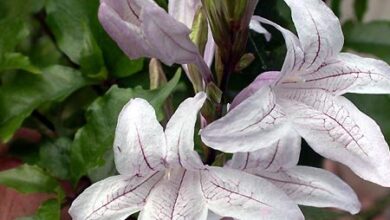
The most graceful Dizygoteca
Dizygotheca graceful is one of the plants of the family called Araliaceae. The name of this plant in Latin is as follows: Dizygotheca elegantissima.
As for the name of the Araliaceae family itself, in Latin it will be: Araliaceae.
Description of growing features
The plant will require a sunny light regime, however, the most graceful Dizygotheca can also develop quite safely in partial shade. In summer, it is recommended to provide the plant with moderate watering, and air humidity should be kept low. The life form of dizygotheca graceful is an evergreen tree. It should be noted that the plant can often be found in a variety of greenhouses, as well as in hallways and office spaces. In addition, dizygoteca graceful is also used for landscaping warm, but at the same time moderately humid rooms. In some cases, it is also permissible to use this plant as a single tub plant.
Dizygoteca graceful can reach a maximum height of two meters. It is important to ensure that the plant is replanted every two years. To replant the plant, you should choose pots of standard proportions. In this case, for replanting you will need to select the following soil mixture: to prepare such soil you will need to take two parts of turf soil and two parts of sand, as well as one part of leaf soil. As for the acidity of the soil, it should be slightly acidic.
If we talk about possible problems with growing this plant, we should mention that Dizygotheca graceata can be affected by scale insects and spider mites. Most often, such adverse effects are explained by excessively dry air. Falling of plant leaves can occur even due to the slightest drying of the soil clod; very sharp temperature changes in both the air and the soil itself can also lead to such consequences.
Throughout the entire dormant period, Dizygotheca graceful will need to ensure an optimal temperature, which should be at least sixteen degrees. The plant will need to be watered rarely, and the air humidity should also be quite low. If Dizygotheca graceata is grown indoors, a dormant period will be forced; this dormant period will last for several months, starting from October and ending with February. This period of rest occurs due to the fact that there is low air humidity, as well as an insufficient degree of illumination in the room.

Reproduction of Dizygotheca graceful occurs in the spring. Such propagation occurs through apical cuttings: growth regulators and soil heating are also used. In addition, reproduction is also possible through air layering, as well as using seeds. However, it should be noted that propagation of dizygotheca graceful by seeds occurs much less frequently.
As for the specific requirements of this plant, it is important to remember that Dizygotheca graceata is distinguished by a special love of light, however, the plant does not tolerate direct exposure to direct sunlight.
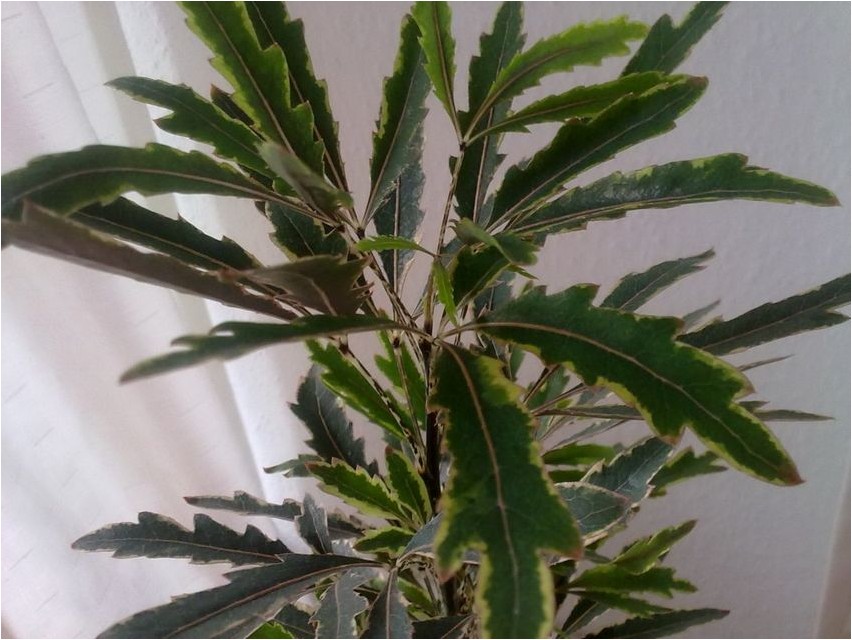
The leaves of Dizygotheca graceful are endowed with decorative properties. These leaves will be quite hard and jagged; the leaves of the plant are ten centimeters long and approximately one centimeter wide. In color, the leaves of Dizygotheca graceful will be green in young plants, but in adults they will already be dark green, endowed with a bronze or silver tint.
It is worth noting that over time, both dark brown and black stripes may appear on the leaf petioles and on the trunk itself. It is important to keep in mind that when grown in an apartment, Dizygotheca gracefula blooms extremely rarely.