Variegated hazel
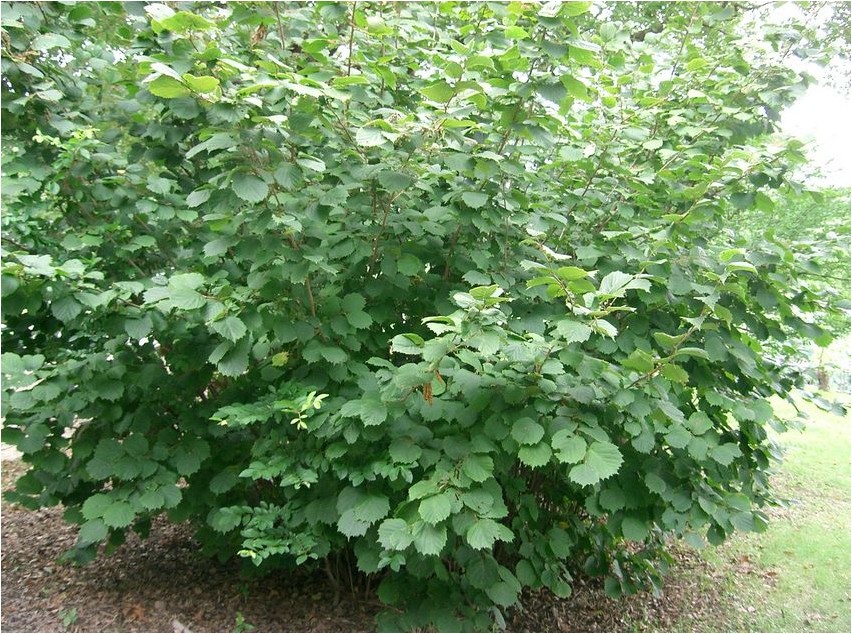
Variegated hazel is one of the plants of the family called Hazelaceae; in Latin the name of this plant will be as follows: Corylus heterophylla Fisch. ex Trautv.
As for the name of the hazel family itself, in Latin it will be: Corylaceae Mirb.
Description of hazel
Variegated hazel is a shrub whose height will vary between two and four meters. Such a shrub will be endowed with dark and slightly flaky bark in old and already dead specimens. Young shoots of hazel are densely pubescent and glandular, but later they will become bare and endowed with sparse and scattered lentils. The buds of this plant are quite small, ovoid in shape, dark in color, they are endowed with rounded, ciliated scales. The leaves of hazel variegated are broadly obovate, rounded or broadly obovate. The length of such leaves will be about six to eleven centimeters, and the width will be five to ten centimeters. At the apex itself, such leaves can be either truncated or almost bilobed, while the main tip most often will not exceed the lateral lobes, and the leaf edges will be unevenly elongated-toothed.
The leaves of this plant are dark green on top, but underneath they are lighter, and the veins will be pubescent. The length of the leaf petioles is equal to a centimeter or two and a half centimeters, they are endowed with glands and are hairy. Variegated hazel blooms in April; the staminate catkins can overwinter openly, and by the time flowering begins they will already be loose and drooping, and their length will not exceed four centimeters. Pistillate flowers are closed by covering scales, and at the moment of flowering, reddish stigmas will appear from such scales. The ripening of nuts begins in September. It should be noted that sometimes some of the leaves of hazel can dry out and remain on the bushes until mid-winter or sometimes until next spring. Under natural conditions, this plant is found in the territory of Primorye and Amur region in the Far East, as well as in the Daursky region of Eastern Siberia. For growth, variegated hazel prefers forest edges, mountain slopes, river valleys, undergrowth of deciduous, oak, mixed and coniferous forests.
Description of the medicinal properties of hazel
Variegated hazel is endowed with very valuable healing properties, and it is recommended to use the fruits of this plant for medicinal purposes.
The fruits of multileaf hazel contain fatty oil. It is noteworthy that the nuts are edible in hot and raw form, and are also quite widely used in the confectionery industry, because highly nutritious flour can be made from them. It should be noted that the kernel of this plant is a nutritious and appetite stimulant. The oil of this plant is used to make artistic paints. In addition, it should also be noted that in forestry this plant is used as an undergrowth species, as well as for hedges, strengthening ravines and protective strips.

In order to improve digestion, it is recommended to use the following remedy based on the nuts of this plant: to prepare such a very effective healing remedy, you will need to take about twenty-one to twenty-four grams of the nuts of this plant. These nuts are then mixed with wine and sugar, after which the mixture is completely ready for consumption. Use this healing remedy based on hazel variegated in the morning and evening before meals: in addition to improving appetite, such a remedy will also help normalize digestion.