Capers
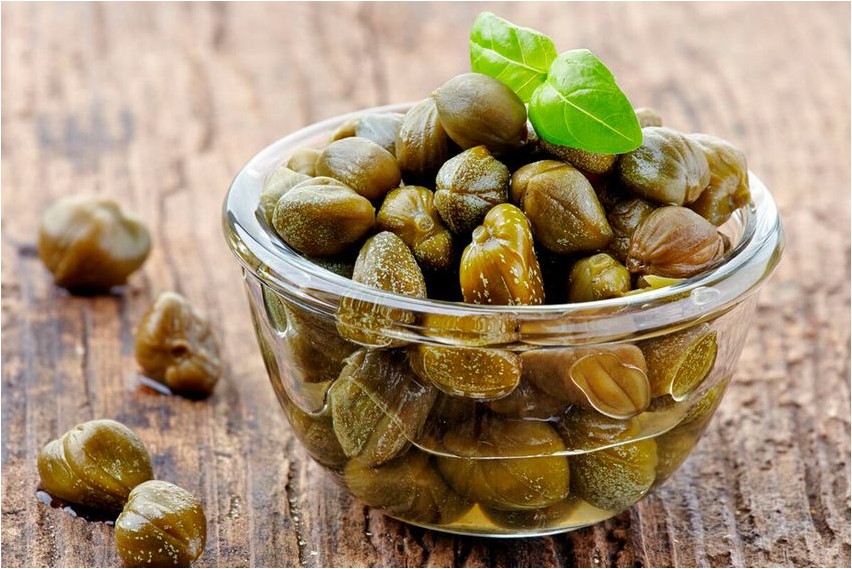
Capers are members of the Caperaceae family, and their Latin name is Capparis spinosa L.
The caper family itself is Capparidaceae Juss.
Description of Capers
Capers are subshrubs with slightly pubescent, creeping branches. The stems can reach approximately one hundred and fifty centimeters in length. The leaves are rounded, either obovate or elliptical, with spiny stipules colored in yellowish tones. The flowers of this plant are quite large, solitary, and approximately five to eight centimeters in diameter. The petals of these flowers are colored in shades of yellow, white, and pale pink. The flowers of the prickly caper grow in the leaf axils. The fruits are oval, berry-like, and quite fleshy, green in color with numerous kidney-shaped brown seeds.
The prickly caper blooms in May. In the wild, this plant is found in Crimea, Dagestan, Central Asia, Eastern Transcaucasia, and Kazakhstan, with the exception of the northern regions. It prefers dry, rocky areas, gravel beds, cliffs, weedy areas, and riverbanks, as well as gravelly, clayey, and alkaline soils.
It should be noted that in Azerbaijan and Turkmenistan, these plants will form unique caper semi-deserts where groundwater is quite deep. Description of the medicinal properties of capers
Capers possess valuable medicinal properties. It is recommended to use the flowers, buds, fruits, and root bark of this plant for medicinal purposes. The roots should be harvested in late autumn, while the buds and flowers should be harvested from May to June, and the fruits are harvested in July and August.
The fruits of this plant contain rutin, steroid saponins, sugar, iodine, thioglycosides, ascorbic acid, a red pigment, the enzyme myrosin, and essential and fatty oils. The flowers and buds of capers contain saponins, quercetin, a coloring agent, rutin, and ascorbic acid. The roots contain the glycoside capparidin, and the bark and leaves contain stachydrin.

The fresh parts of this plant are endowed with antiseptic, diuretic, astringent, analgesic and antiseptic effects. It is recommended to lubricate wounds with the juice of prickly caper flowers, and this juice should also be drunk for scrofula.
For toothache, you should chew the fresh bark of the roots of this plant, and this bark can also be applied to festering wounds. As for traditional medicine, the fruits of this plant are used for gum diseases, toothache, hemorrhoids and thyroid diseases.
In crushed form, the bark of the roots of prickly capers is used for rheumatism. A decoction prepared from the bark of the roots of this plant is used for paralysis, hysterical seizures, angina pectoris, diseases of the spleen and liver, as well as for jaundice and colds and rheumatic fever. The same decoction can be used to lubricate the skin with scabies.
A decoction of the twigs and leaves of this plant is recommended for use in diabetes mellitus, and the seeds are used for headaches. It should be noted that this plant can be eaten. The fruits and buds of prickly capers are used as seasonings for cold appetizers, and pickled shoots and flower buds will add a rather pleasant sour taste to fish and meat dishes. It is noteworthy that Uzbeks and Armenians use ripe berries of this plant in cooking.
57202; WELL, THESE CAPERS OF YOURS are disgusting&





