Lucuma
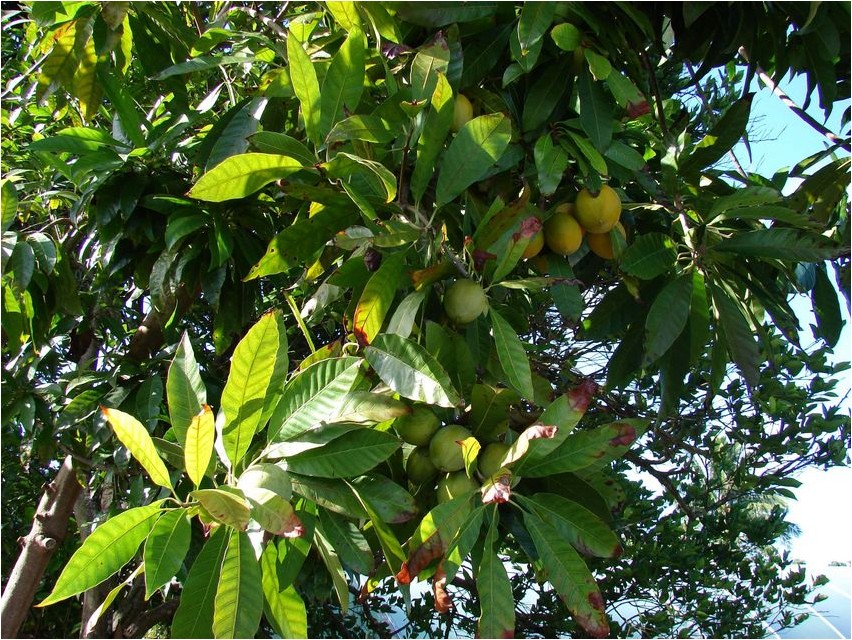
Lucuma (Latin: Pouteria lucuma) is an evergreen fruit tree belonging to the Sapotaceae family.
Description
Lucuma is a small tree growing from eight to fifteen meters tall, covered in thick brown bark containing a large amount of sticky, milky-colored latex. The trees have dense crowns, and the oval or elliptical leaves are leathery. They are quite pale underneath and bright dark green above. Their length ranges from twelve and a half to twenty-five centimeters. The flowers of this plant are borne in leaf axils, one to three at a time.
Lucuma fruits, which can be either oval or flattened elliptical, reach seven and a half to ten centimeters in length. Their skin has an attractive reddish-brown blush. The pulp inside the fruit is sweet, starchy, quite dry, and very firm. Until it”s overripe, it”s generously saturated with latex. Within the pulp are glossy, black-brown seeds, numbering between one and five.
Each mature tree can produce up to five hundred kilograms of fruit per year. In South American countries, lucuma has regularly saved countless people from certain death during lean years, as well as during epidemics of various diseases or pest infestations. This is why it has earned the rather flattering name “tree of life,” and Americans affectionately call it “the lost harvest of the Incas.”
Where it grows
Lucuma is native to southeastern Ecuador, Chile, and Peru. Nowadays, this fruit is grown not only in its historical homeland but also in Mexico and Costa Rica, as well as Hawaii and Bolivia. Lucuma can grow at altitudes of up to three thousand meters.
Uses
Lukuma is eaten fresh, canned, stewed in its own juice, made into a wonderfully refreshing juice, or the pulp is added to pies. However, most often, the fruit is dried and then ground into a powder and used as an additive to ice cream or sweet desserts. The frozen pulp is widely exported to other countries.

These fruits are considered an excellent source of beta-carotene — it is from which the human body subsequently synthesizes vitamin A. It is rich in lucuma and vitamin C, and also contains a lot of niacin, which prevents the formation of blood clots and plays an important role in the prevention of diseases such as atherosclerosis. And the high content of phosphorus and iron makes this attractive fruit incredibly beneficial for healthy teeth and bones. In addition, lucuma will be useful for excessively heavy menstruation, as well as during the recovery period after serious illnesses and after all kinds of surgical interventions.
Lucuma is also recommended for consumption by people who have problems with tissue regeneration, and the fiber contained in these fruits perfectly helps to cope with constipation and has a beneficial effect on the functioning of the gastrointestinal tract.
And since lucuma boasts a fairly high sugar content, its powder is often used as a sweetener. By the way, recently it has been actively used in the production of baby food (instead of sugar) — its powder can often be seen in all kinds of milk formulas. And the calorie content of this fruit is very high — 329 kcal for every 100 g of pulp (chocolate and very fatty meat have approximately the same calorie content).
As for lucuma seeds, they are very rich in oil, which is famous for its high cosmetic value.
Contraindications
You should not eat lucuma if you are obese or have diabetes, as it is very high in calories and is rich in sugars. Individual intolerance cannot be ruled out. Also, to avoid caries, your mouth should be rinsed with water after eating lucuma.