Licorice paleflower
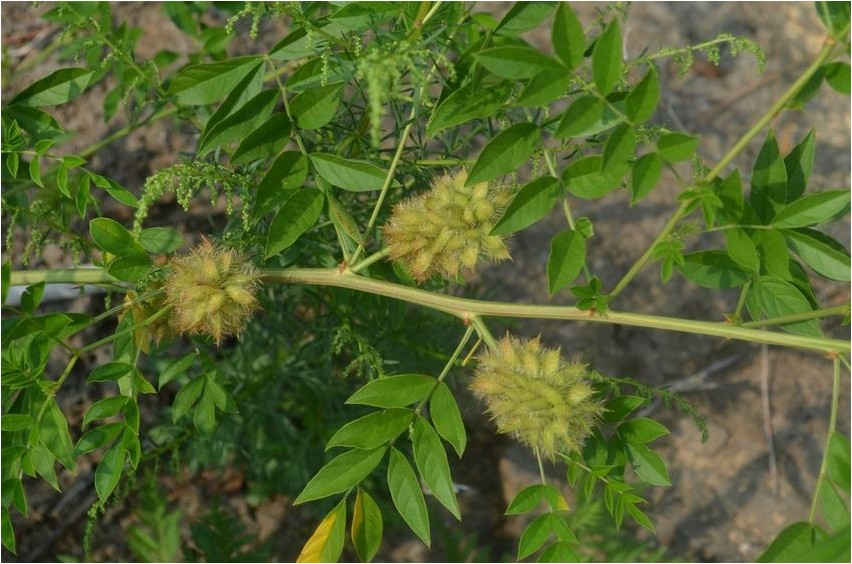
Licorice pale-flowered is one of the plants of the family called legumes; in Latin the name of this plant will be as follows: Glycyrrhiza pallidiflora Maxim.
As for the name of the pale-flowered licorice family itself, in Latin it will be: Fabaceae Lindl. (Leguminosae Juss.).
Description of Licorice paleflower
Licorice pale-flowered is a perennial herbaceous plant, endowed with powerful stems; the height of such a plant will fluctuate between one hundred and one hundred and twenty centimeters. The leaves of this plant are endowed with four to six pairs of leaflets, the length of such leaflets will be about three to five centimeters, and the width will be one to two centimeters, in addition, the leaves are endowed with pinpoint glands. The flowers of Licorice pale-flowered are painted in pale purple tones, and they are found in dense inflorescences. The beans of this plant are crowded into spherical heads, and they are also endowed with rather long and thin spines.
It is noteworthy that so far all that is known for certain is that this plant grows under natural conditions only on Lake Khanka and near Khabarovsk. For growth, pale-flowered licorice prefers old deposits, coastal pebbles and the foot of clay outcrops. It should be noted that this plant will grow in relatively small groups.
Description of the medicinal properties of licorice paleflower
Licorice pale-flowered is endowed with very valuable healing properties, and it is recommended to use the roots of this plant for medicinal purposes.
The presence of such valuable healing properties should be explained by the content of coumarins, triterpene saponins, pterocarpanes, flavonoids and the following organic acids in the roots of this plant: tartaric, citric, succinic, fumaric and malic. The roots also contain triterpenoids in the hydrolyzate: echinate, meristotropic and macedonic acids. The aerial part of Licorice paleflower contains flavonoids and coumarins; the leaves contain ascorbic acid, flavonoids kaempferol, apigenin and quercuetin, as well as the following organic acids: malonic, tartaric, fumaric, citric, oxalic, gluconic, succinic and malic.

The roots of this plant are used for ascites, and are also used as a very effective mild laxative, expectorant and enveloping agent.
As for traditional medicine, pale-flowered licorice has become quite widespread. This plant is used for colds, various stomach diseases, and is also used as an anthelmintic.
It should be noted that the experiment proved that meristotropic, echinatic and macedonic acids have an effect that is similar to glucocorticoid. Actually, for this reason, pale-flowered licorice turns out to be close in its effects on the body to Western types of licorice. It should be noted that such species were officially recognized as medicinal plants. However, most often various medicinal products will contain not pale-flowered licorice, but smooth licorice or Ural licorice.
In addition, it has been proven that such acids are endowed with the ability to exhibit very intense anti-inflammatory activity.
Also, during an experiment that involved feeding the leaves of this plant to animals, it was proven that the leaves of Licorice paleflower are endowed with the ability to exhibit estrogenic activity. It should be noted that pale-flowered licorice is a rather promising medicinal plant.





