Mühlenbeckia
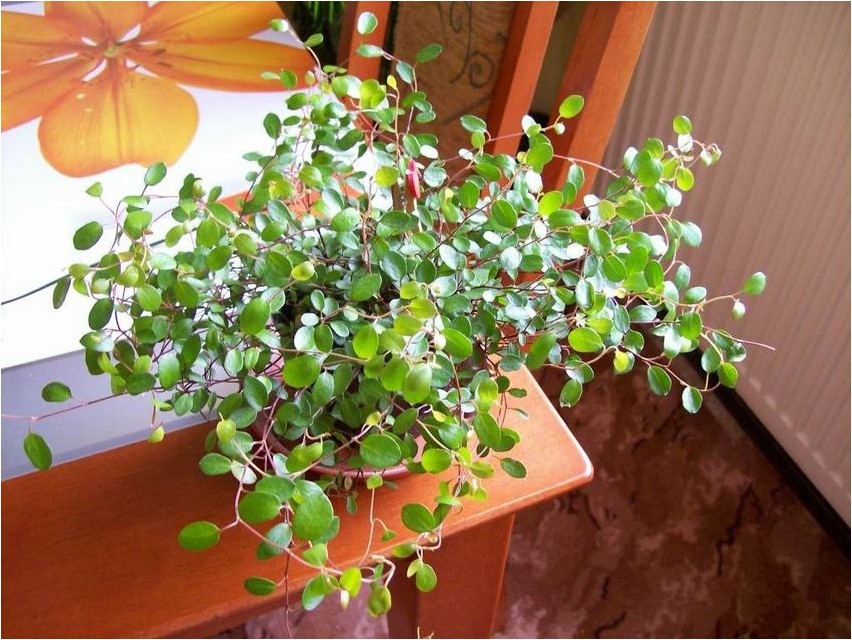
Muehlenbeckia (lat. Muehlenbeckia) is a vine plant from the Buckwheat family.
Description
Mühlenbeckia is an evergreen subshrub or perennial shrub, equipped with a huge number of spectacular climbing shoots. And its brownish or brownish thin branches are very densely intertwined with each other. This plant can be either climbing or creeping. As for the length of the shoots, it ranges from fifteen centimeters to three meters.
The diameter of the round and very small petiole leaves of Mühlenbeckia almost never exceeds two centimeters. All leaves are arranged alternately on the stems, and their shape can be either broadly ovoid or rounded, although sometimes there are lobed leaves with rounded or truncated bases. Just above the places where the petioles are attached, the stems are covered with strong membranous sockets. By the way, in winter, when Mühlenbeckia enters a dormant period, it partially sheds its miniature leaves.
The few-flowered axillary inflorescences of this plant are usually racemose in shape, and the five-membered flowers formed on them can be either bisexual or unisexual. They are painted white (a little less often they can be yellowish or greenish), and their diameter reaches 0. 6 cm.
Where does it grow
Most often you can see muhlenbeckia in New Zealand and on the distant Australian continent.
Usage
Mühlenbeckia is used mainly as a climbing or hanging plant (in the latter case it is placed in hanging vases).

Growing and care
Mühlenbeckia should be planted in bright areas, but in summer it must be thoroughly shaded from too bright sun. And in winter, the temperature of Mühlenbeckia should be around fifteen degrees.
Water this plant as the soil dries out, trying not to allow the earthen ball to dry out excessively (so that the leaves do not begin to fall off prematurely). However, we should not forget that excess moisture is also dangerous for this plant. Water intended for irrigation should ideally be allowed to settle (purified water is a good alternative), and its temperature should be between eighteen and twenty-two degrees. In addition, Mühlenbeckia simply loves regular spraying with water.
In the summer, the green pet is fed with full-fledged fertilizers (usually feeding begins somewhere from mid-spring until the beginning of autumn) at a two-week interval, and Muhlenbeckia is usually replanted with the onset of spring (and not every year), and it is better to do this in an earthen mixture of equal parts of sand, peat, humus and turf soil. Replanting is best done by transshipment, since its extremely vulnerable root system can be damaged very easily. Among other things, Muehlenbeckia should also be provided with good drainage.
This plant is propagated by mature cuttings, which are placed in moss with sand or peat with the soil heated to twenty degrees. And when the cuttings take root, they are planted in pots, several in each. Mühlenbeckia can also be propagated by seeds, but this method is used exclusively in the first two spring months. Sowing seeds on the soil surface is carried out in a chaotic manner. As for seedlings, they are usually grown in greenhouse conditions.
In general, Mühlenbeckia is quite unpretentious and requires a minimum of time and attention for care, which makes it a particularly valuable acquisition in the eyes of many plant growers. By the way, diseases and pests attack muhlenbeckia also extremely rarely!


