Creeping Buttercup
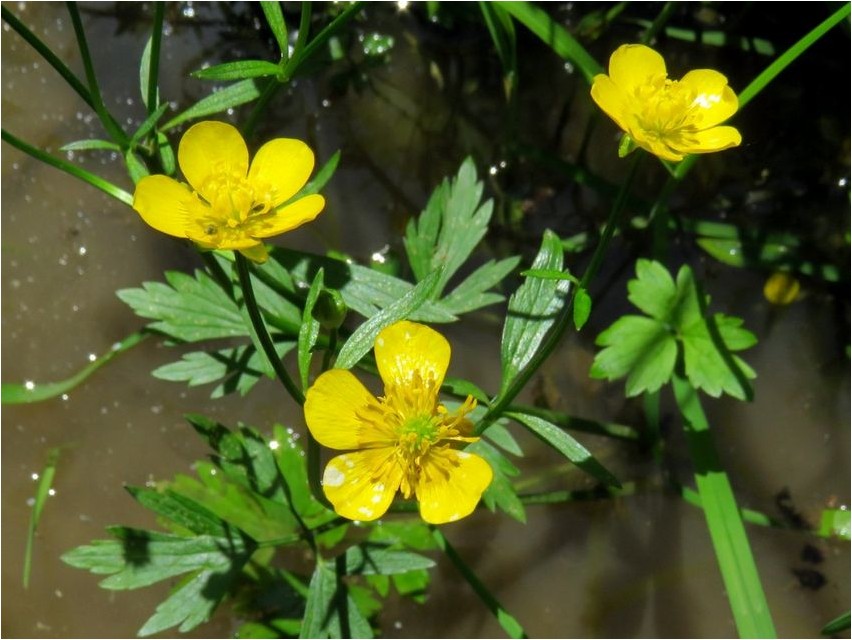
Creeping buttercup is a member of the buttercup family, and its Latin name is Ranunculus repens L.
The family name of creeping buttercup itself is Ranunculaceae Juss.
Description of Creeping Buttercup
Creeping buttercup is a perennial herbaceous plant with hooked roots. Its stem is tall, reaching between 30 and 80 centimeters in height. Its stem is branched, straight, and furrowed, and may be bare or covered with erect hairs extending halfway down the stem. The basal leaves of this plant have a rounded, heart-shaped blade and a rather long, scalloped petiole. Basal leaves, almost to the very base, will have three- to five-lobed lobes, which will be elongated and lanceolate, slightly widening toward the top, and also incised-toothed. The upper stem leaves of creeping buttercup will be two- to four-lobed, with serrated or linear-lanceolate lobes with entire margins. Remarkably, the leaf blades of this plant are endowed with appressed hairs on both sides, and the underside will be pale green. The peduncles of this plant are endowed with appressed hairs. Creeping buttercup flowers are typically numerous, and their diameter is about two to three centimeters. The sepals of this plant are obtuse, ovate, and endowed with erect hairs along the edges. Creeping buttercup petals are usually only five to seven in number, and they will be colored bright yellow. The receptacle of this plant is notably hairy. The creeping buttercup fruit is a compound achene, consisting of many achenes.
In the wild, this plant is found in Western Siberia, the mountains of Central Asia, southern Eastern Siberia, European Russia, Ukraine, and Belarus. It prefers light forests, clearings, forest edges, clearings, embankments, gardens, fields, and dry floodplain and upland meadows.
Creeping buttercup blooms from June to August.
Description of the medicinal properties of creeping buttercup
Creeping buttercup is endowed with very valuable healing properties, and it is recommended to use the herb of this plant for medicinal purposes. The concept of grass includes the flowers, leaves and stems of this plant. It is recommended to harvest such medicinal raw materials throughout the entire flowering period of creeping buttercup.

The presence of such valuable healing properties should be explained by the content of carotene, quinoin, saponins, ascorbic acid, tannins, coumarins, alkaloids, flavonoids and lactones in this plant.
It should be noted that this plant is poisonous, for this reason extreme caution is recommended when handling this plant. Creeping buttercup herb should be used externally and in the form of compresses for gout, rheumatism, wounds, boils, headaches and neuralgic pain.
A decoction prepared from the creeping buttercup herb is recommended for washing skin that has been affected by scabies. In addition, it is recommended to apply crushed fresh leaves of this plant to abscesses and boils in order to speed up their maturation. When used correctly, such healing remedies based on creeping buttercup turn out to be very effective and the positive effect will be noticeable quite quickly.





