Nanophyton hedgehog
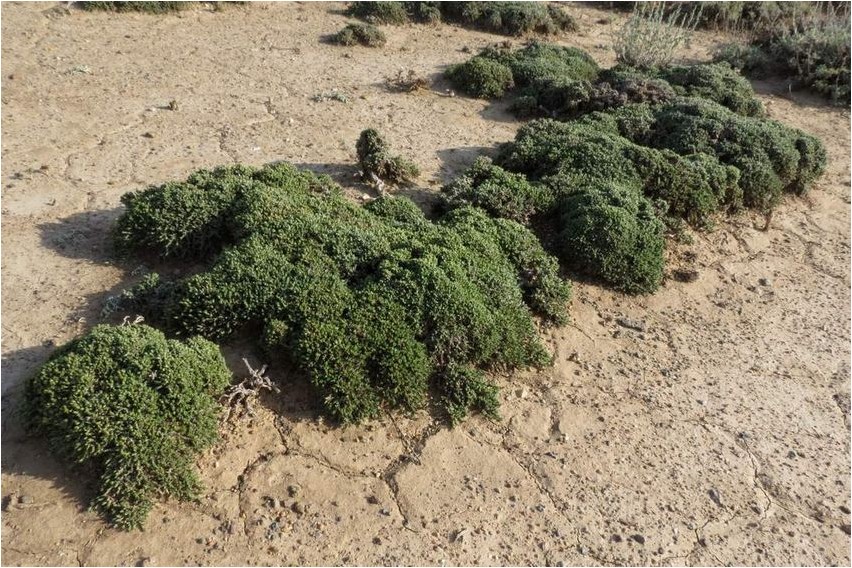
Nanophyton hedgehog is one of the plants of the family called Chenopoaceae; in Latin the name of this plant will be as follows: Nanophyton erinaceum (Pall) Bunge.
As for the name of the hedgehog nanophyton family itself, in Latin it will be: Chenopodiaceae Vent.
Description of hedgehog nanophyton
Nanophyton hedgehog is a subshrub, the height of which will fluctuate between five and fifteen centimeters. The plant will form dense, hard and cushion-shaped turf. Most often, the stems of this plant are woody and very thick. The leaves of Nanophyton hedgehog are densely spaced and alternate, while they will completely hide the stems, they will be bare or may be endowed with tubercles, and a tuft of long hairs will be present in the axil. The flowers of this plant are located in the axils of the upper leaves, singly and with bracts. The perianth lobes of Nanophyton hedgehog are filmy, and when fruiting they will expand in a bubble-like manner. The fruit of the hedgehog nanophyton is fleshy, it will be on a rather short stalk, and its length will be about three millimeters.
This plant blooms from August to September. Under natural conditions, the hedgehog nanophyton is found in Central Asia, the Angara-Sayan region of Eastern Siberia, in the Zavolzhsky and Lower Volga regions of the European part of Russia, as well as in the Altai and Upper Tobolsk regions of Western Siberia. For growth, this plant prefers salt marshes, chalk deposits, takyrs, gravelly and rocky slopes, as well as foothill trails.
Description of the medicinal properties of hedgehog nanophyton
Nanophyton hedgehog is endowed with very valuable healing properties, and it is recommended to use the herb of this plant for medicinal purposes. The concept of grass includes the stems, flowers and leaves of this plant.
The presence of such valuable healing properties is recommended to be explained by the content of alkaloids and saponins in the composition of hedgehog nanophyton. Alkaloids will help lower blood pressure. The drug, created on the basis of this plant, is indicated for use in hypertensive crises, various skin diseases and hypertension.

For the treatment of fungal infections of the scalp, a highly effective remedy based on this plant is recommended. To prepare this remedy, you will need about five to six tablespoons of the herb, Nanophyton edulis, per liter of water. The resulting mixture is recommended to be simmered over low heat, after which the remedy can be used only after it has cooled. Remarkably, this remedy based on Nanophyton edulis is characterized by a fairly broad spectrum of effectiveness. As for the frequency of use, this remedy based on this plant should be used at least once a week. In this case, and with proper use, various fungal infections of the scalp will disappear in the shortest possible time. However, the speed of effective results will depend on the severity of the fungal infection itself, as well as the nature of the fungal infection itself.
It should be noted that the chemical composition of Nanophyton edulis has not yet been adequately studied. For this reason, new uses for this medicinal plant may emerge in the near future, as hedgehog rhododendron still has great healing potential.





