Borage
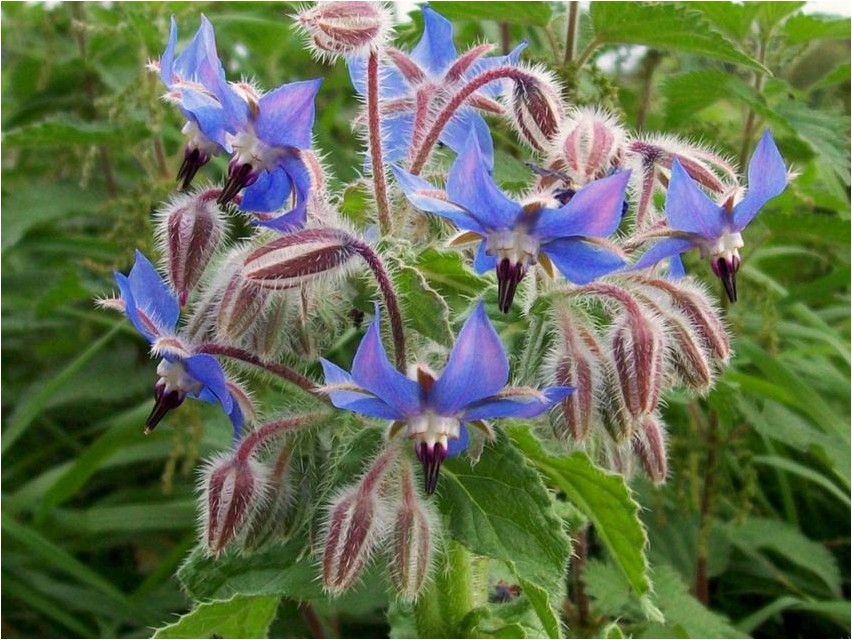
Borago (Latin: Borago) is a monotypic genus of plants in the Boraginaceae family. The plant is also known as Borage, Starflower, and Borago.
The only species in the genus is Borage officinalis. In the wild, borage grows in southern Europe, North Africa, South America, and Asia Minor. It is native to Syria. The plant’s taste and aroma resemble cucumber, which explains its widespread use in cooking. Borage is also used in folk medicine.
Crop Characteristics
Borago is an annual, herbaceous, coarse-haired plant up to 100 cm tall. It has a taproot system. The stem is thickened, ascending or straight, ribbed, hollow, and highly branched at the top. The basal and lower leaves are fleshy, obtuse, elliptical or oval, and sit on short petioles. The upper leaves are sessile, covered with whitish hairs, clasping the stems, and oblong-ovate.
The flowers are small, gathered in whorls, and borne on long pedicels. The calyx has linear-lanceolate lobes and is densely hairy. The corolla is whitish or dark blue with a pinkish tint, usually longer than the calyx, and has a short tube. The fruit is a finely tuberculated nutlet of oblong-ovate shape. The seeds are black or brown, oblong, ribbed, and relatively large.
Borage blooms from June to August. The fruits ripen from July to September. Borage is highly cold-resistant and does not tolerate heat well. With prolonged exposure to elevated temperatures, the leaves become very coarse, and the flower-bearing stem forms prematurely from the basal rosette. Growing Conditions

Borage prefers sunny areas with filtered light; when sown in summer, semi-shaded areas are preferred. Fertile, moderately moist, loose soils with a neutral pH are preferred. The plant can also thrive in poor soils, but in this case, a harvest of juicy and tasty leaves should not be expected.
Sowing
Borage can be sown either before winter or in early spring. It is possible to sow the crop in different seasons during the summer, but not before August. Winter sowing is carried out in September. The seeding depth is 1. 5-2 cm. Sow borage in rows at intervals of 25-30 cm. Seedlings appear 6-7 days after sowing.
Care and Harvesting
Caring for cucumber grass involves weeding, loosening the rows and watering. Thinning is carried out as necessary in the phase of 2-3 true leaves. Systematic watering, during drought with increasing water volumes. Feeding is optional, but even without it the plants develop well.
Harvest 15-20 days after germination, but before the plant produces a flowering stem. At a young age, borage is very tender and tasty; later, the leaves become rough and not so fragrant. Typically, the yield of green cucumber leaves is 500 g per 1 sq. m.
Application
Despite the fact that many gardeners consider borage to be a weed, in Western European countries the plant is cultivated as a vegetable. Leaves and flowers are used as food, and the flowers are consumed both fresh and candied. Borage is added to vinaigrette, okroshka, cold vegetable soups, various salads, side dishes and sauces. Borage roots are used to prepare green oil, cold drinks, beer, essences, syrups, tinctures, etc. Borage adds flavor to meat and fish dishes. The flowers of the plants are used in confectionery and liquor production.
Borage is also widely used in folk medicine. The plant is believed to be useful for rheumatism, skin diseases, and gout. Borage is used as a mild laxative, sedative, diaphoretic, diuretic and enveloping agent. When combined with other herbs, borage helps prevent inflammatory processes in the gastrointestinal tract and kidneys. The plant is recommended for diseases of the liver, circulatory system and gall bladder.
Borage or borage





