Iris fine-leaved
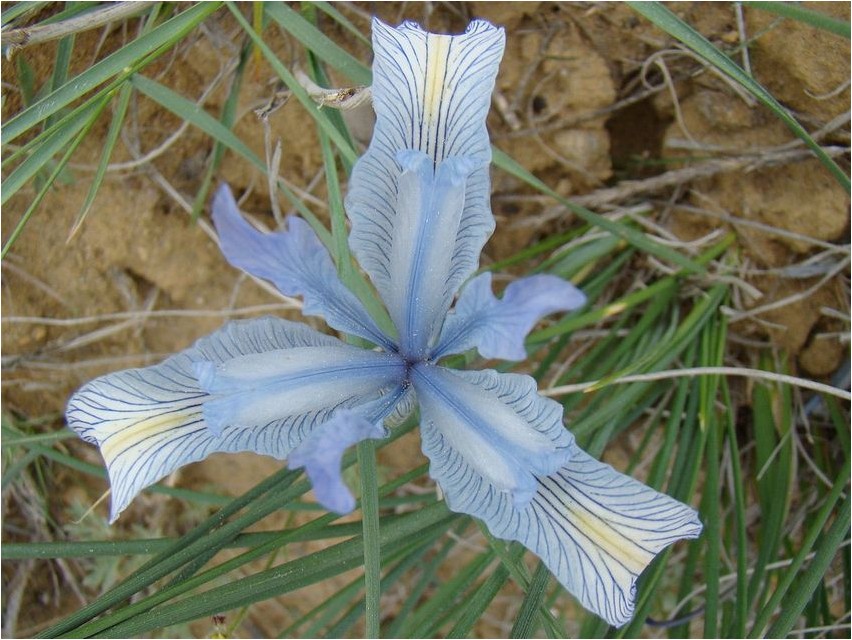
The thin-leaved iris is one of the plants of the family called iris, in Latin the name of this plant will be as follows: Iris tenuifolium Pall.
As for the name of the thin-leaved iris family itself, in Latin it will sound like this: Iridaceae Juss.
Description of iris thin-leaved
Iris thin-leaved is sometimes also called iris thin-leaved. Iris thin-leaved is a perennial herbaceous plant, the height of which will fluctuate between twenty and forty centimeters. The rhizome of this plant is creeping and thin, at the top it will branch, and also forms dense turfs, which will be covered with brownish, durable fibrous remains of leaf sheaths. The stem of this plant is most often underdeveloped or may be very hidden in leaf tufts and will also be very short. The length of the basal leaves will be about forty centimeters, and the width will be approximately one and a half centimeters. The basal leaves are linear-filamentous. There are two flowers; they can be either light blue or purple. Such flowers are very fragrant, and the pedicels are quite short in length. The fruit of the thin-leaved iris is an oval box, it will be rounded-triangular, its length will be no more than four millimeters. The fruit of this plant has a short spout. The seeds will be cube-shaped, they are endowed with a wrinkled shell, and such seeds are colored black and brown.
The thin-leaved iris blooms from April to May. For growth, this plant prefers sand, sandy river banks and desert steppes. Under natural conditions, this plant can be found on the territory of the European part of Russia in the Lower Volga region, in Central Asia, in the Daursky region of Eastern Siberia, as well as in the Verkhnetobolsky region of Western Siberia. As for the general distribution, thin-leaved iris can be found in China and Mongolia.
Description of the medicinal properties of fine-leaved iris
Iris tenuifolia possesses valuable medicinal properties, and its seeds and roots are recommended for medicinal purposes. In folk medicine, a decoction made from the roots is widely used. This decoction should be prepared using thirty to sixty grams of roots: this remedy is considered effective for menorrhagia and fetal distress. A decoction made from Iris tenuifolia seeds is also widely used. This decoction is prepared from three to nine grams of seeds and is used for nosebleeds, bloody vomiting, acute epidemic hepatitis, hernias, urinary incontinence, bone tuberculosis, and uterine bleeding.
For external use, powdered Iris tenuifolia seeds are used. These seeds are used as a dusting powder for various external bleeding caused by soft tissue injuries. For bloody vomiting, difficult urination, and uterine and nosebleeds, the following remedy is recommended: to prepare this remedy using Iris tenuifolia (Iris tenuifolia), take eight grams of seeds per two hundred milliliters of water. Boil the resulting mixture in a water bath for fifteen minutes, then strain thoroughly and add boiled water to bring the original volume up to the original volume. Take half a glass of this herbal remedy three to four times daily before meals, slowly and in small sips.

Iris tenuifolia: Spring Care and Feeding