Cherry diseases and methods of combating them
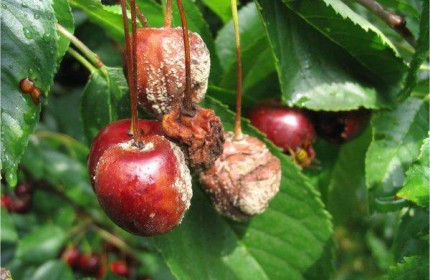
First, let”s look at cherry coccomycosis, the causative agent of which is considered to be a fungus. By infecting trees, the pathogen causes enormous leaf loss and rapid spread of cherry diseases and their treatment. Red-brown spots on cherry leaves appear during infection, eventually merging with the area of dead tissue. In winter, trees are greatly weakened, as a result of which shoots, buds, and branches die, and the next year the yield becomes scanty. During the occurrence of epiphytoty, the death of fruit-bearing trees occurs. Green fruits are also infected with the fungus. In winter, it is found on leaves that have fallen and on fruits that remain hanging. Apotentia with bags and sacspores are formed on them. Once ripe, the sacspores infect the budding cherry leaves. In summer, the disease spreads with the help of conidia, which have a cylindrical shape and dimensions of 36-65 x 3-5 microns. They are the main source of infection and the place of their formation — under the epidermis. First, let”s look at cherry coccomycosis, the causative agent of which is considered to be a fungus. By infecting trees, the pathogen causes enormous leaf loss and rapid spread of cherry diseases and their treatment. Red-brown spots on cherry leaves appear during infection, eventually merging with the area of dead tissue. In winter, trees are greatly weakened, as a result of which shoots, buds, and branches die, and the following year productivity become scanty. During the occurrence of epiphytoty, the death of fruit-bearing trees occurs. Green fruits are also infected with the fungus. In winter, it is found on leaves that have fallen and on fruits that remain hanging. Apotentia with bags and sacspores are formed on them. Once ripe, the sacspores infect the budding cherry leaves. In summer, the disease spreads with the help of conidia, which have a cylindrical shape and dimensions of 36-65 x 3-5 microns. They are the main source of infection and the place of their formation is under the epidermis.
You can get rid of this disease by destroying the source of the primary infection — overwintered leaves. In the fall, it is necessary to treat the trees with one percent Bordeaux mixture (this is done only after the fruits have been collected) or with copper oxychloride, ninety percent. p. (30-40 grams). And if a large number of moths or moths appear, then it is worth using lipidocide preparations (20-30 grams per 10 liters of water) or bitoxybacipin (40-80 grams), adding copper oxychloride (30 grams) or one percent Bordeaux mixture.
Enough resistant varieties cherry trees to this disease: carpal, felt, Novodvorskaya.
Another disease that can affect cherries and even sweet cherries is Witches” Brooms. This is a disease of viral origin. Its development takes place in two stages. First, increased cell division begins without external signs of damage. At this time, chlorophyll is destroyed. Next, the cells increase their volume and divide again. As a result, shoots are formed that are located close to each other, on which many branches and small leaves appear. Affected shoots do not produce flowers. In diameter, “witches’ brooms” can reach enormous sizes — from 1 to 3 meters. Several of them can grow on a tree.
They can be overcome by pruning the affected shoots, and if there are large numbers of trees, critically infected plants are cut down. These are cherry diseases and their treatment.