Cordilina
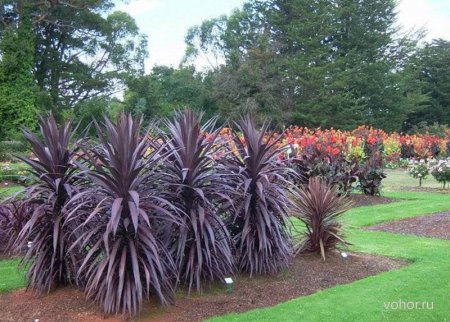
For its ability to misinterpret the question of novice gardeners, this houseplant could be called deceptive cordyline.
Indeed, it is very difficult to imagine that a small, neat bush, as it looks at a young age, will then turn into something similar to a natural palm tree. True, such a transformation will occur over time and over a very long period.
Cordyline also has the ability to get into the house masquerading as dracaenas. Since in free trade it can often play a role like Dracaena apex, straight or undivided. Such confusion does not have a huge or fundamental difference, since in appearance the representatives of these 2 genera are, in fact, very similar. And their true integral sign is consistent with the legendary expression “Look to the root.” Dracaena roots have smooth, even roots that are yellow or orange when cut. In Cordyline, the underground component is represented by a white, very powerful rhizome with swelling nodes in which the plant stores a supply of nutrients. This is where the name of the genus comes from, which in Greek means “knot” or “nodule”.
The genus Cordyline belongs to the large agave family and is represented in the wild by 15-20 species, growing in tropical and subtropical zones on all five continents of the globe without exception. These are trees, shrubs or subshrubs, which in their natural habitat are quite impressive in size – from 3 m in height. However, it is clear that it will not be possible to grow such giants in the home requirements. Cordyline flowers are small, white, lilac or reddish in color, collected in a not very large panicle; they have no unusual picturesque value. Among other things, in domestic situations, their appearance is hardly worth waiting for. As a result, this plant is cultivated only for the purpose of beautiful leaves and is widely used for indoor landscaping of large and empty rooms, although very often it can be found among the green residents of ordinary apartments.
Cordyline leaves are leathery and can reach up to 1 meter in length. They are narrow, linear, or broadly lanceolate, saber-shaped, with smooth or slightly serrated edges. Coloration varies from dark green to light, almost gray, with a burgundy border along the edges or longitudinal stripes of contrasting colors. There are also red-leaved subspecies and cultivars.


terminal, border, or shrubby. It can also be casually purchased under the name Dracaena terminalis. This is the most common species, but it also offers a huge variety of cultivars. The leaves are relatively spacious, 7-10 cm in the middle, lanceolate with a rounded or pointed apex. They grow to 30-50 cm in length, on petioles 10-15 cm long. The stem is slender—up to 1. 5 cm in diameter, occasionally branching, and developing very slowly. The leaves of the common variety are green, but the Kiwi variety, in particular, has wide, light-colored longitudinal stripes with a bright pink edge. The Canario variety has leaves reminiscent of a watermelon stripe, and the Mambo variety has beetroot-red leaves with a purple tint. This species is native to East India, the Malay Archipelago, the Hawaiian Islands, and tropical Australia. As a result, the plant is very heat-loving and demanding of light conditions.
Undivided, on sale can also catch your eye masquerading as Dracaena undivided. Under normal conditions, this is a large and tall tree with a distinct, unbranched trunk. This is why it got its name. The leaves are tall, belt-shaped, can be much more than a meter long, and within 10 cm wide. The color is green, non-shiny, lighter on the base side. The defining vein – yellow or red – stands out clearly. From time to time there is a reddish border along the edges. Cordyline undivided is one of the most unpretentious species. It comes from the subtropics of New Zealand, as a result of which it is grown in indoor floriculture in fresh rooms, and in areas with mild winters it is even cultivated in open soil.
Southern or Australian (Dracaena southern), like the previous species, comes from New Zealand, therefore it is also quite unpretentious, but needs a cooling wintering. The leaves are tall, narrow (within a width of 3 cm), sessile, which is why this plant mainly looks like a dracaena. Their color is primarily green with a prominent clear typical vein. But there are variegated varieties – with narrow yellow or red longitudinal stripes. Southern Cordyline has fragrant flowers, but at home it literally does not bloom.
Straight, catches the eye with the name Dracaena straight. An inherent feature of this species is a neat coffee trunk with narrow and not small sessile leaves evenly spaced on it. The trunk is brown with distinct marks of dead leaves. Leaf blades are up to 60 cm long, 1. 5–3 cm wide, with pointed apices and jagged edges. Green non-shiny or purple-bronze. Homeland – subtropical zones of Eastern Australia.
Banks – in appearance it is terribly similar to the southern cordyline, but the leaves are more delicate and slightly wider – up to 5 cm at the widest part. The trunk develops neat and even. The leaf blade is attached to petioles 15–20 cm long. It is recommended to grow in fresh rooms, since the usual habitat is mountain forests and the coastal region of New Zealand. Meanwhile, this species adapts well to other growing conditions.
Care and cultivation of Cordyline

cordilina equally does not like both stagnation of water and drying out of the earthen coma; she chooses nutritious, slightly acidic soil. As a result, a soil mixture of sand, peat and turf soil in similar proportions, or peat, sand, humus and leaf soil also in a 1:1:1:1 ratio, is suitable for its cultivation. It is also possible to add brick chips, which will absorb excess water and crushed charcoal – in the interests of preventing root rotting.
Since cordyline grows at a slow pace, it is not at all necessary to plant it immediately in a huge container. The growing container must match the size of the plant. In the interests of a young compact bush, a pot with a diameter of 12-15 cm is suitable, and after that, over time, after a certain number of transplants, it is quite possible to reach a not very large tub.
Cordyline’s lighting conditions are typical. There should be a lot of light, but not direct, but slightly diffused. This type of light can be provided, in particular, by a light tulle curtain on a window facing the afternoon side. Although it is recommended to move the cordilina to the southern window opening only for the winter, in the summer the best location for it is considered to be western or eastern windows. If there is a lack of light in winter, it is quite possible to use artificial lighting.
Taking into account the tropical or subtropical origin, any species has every chance of having all sorts of preferences for temperature conditions. During the vigorous growing season, which in most cases lasts from mid-March to the end of September, a temperature of 20–25 degrees Celsius will be suitable for both. After this, before the onset of the resting stage, it is appropriate to gradually reduce it: in the interests of heat-loving species – to approximately + 18 ° C, and for natives of the subtropics to 5–10 ° C. Sudden temperature changes should be avoided, and the plant should also be protected from drafts.
It is appropriate to water the cordilina systematically with soft and settled water. In spring and summer – within 2 times a week, in winter – in most cases no more than once every 5-6 days. The cooler the room, the less frequent watering should be. Plants with broad leaves require more moisture than narrow-leaved plants. Both with stagnation and with a lack of water, a wide “leaf fall” can occur.
Tropical species of cordilines feel good only with high air humidity, which can be created artificially by placing the pot on a layer of damp pebbles and sand. They will need systematic, in the summer – I would like daily, spraying of the leaves on both sides. And watering and spraying will be carried out in such a way that water does not accumulate in the axils of the leaves, since this can lead to rotting of the stem.
During the most active growth, which occurs in April-August, plants need additional feeding, in the form of which you can use comprehensive complex fertilizers for indoor deciduous plants. Fertilizers are applied both by root and foliar methods (at the same time as spraying). The frequency of root feeding is once every two weeks, foliar feeding is weekly. In the autumn-winter period, feeding is reduced to once a month, and plants located in cool areas are not fed at this time.
Cordyline is replanted at a young age once a year, and large plants – once every two or three years. A reliable sign that new dishes are needed is that the entire earthen ball is filled with roots, and at the same time, the roots even have every chance of coming out through the drainage holes. One of the best times for transplantation is spring. Each time a new container is selected 1. 5–2 cm wider in diameter; at the bottom there must be a clear drainage layer of miniature pebbles or expanded clay, at least 3 cm high.
Reproduction of cordyline

cordyline grown at home is not propagated by seeds, but the most reliable vegetative method is by dividing the rhizome. In most cases, root cuttings are isolated from the mother plant during the transplantation period. They are accepted very well in a light substrate of a mixture of moss and sand, and after that they are transplanted into a pot with special soil.
Stem cuttings are also used for propagation. To do this, take a part of a semi-lignified shoot – the apical or middle part with several points of increase. They are placed in a special substrate at a temperature of 20–25 degrees Celsius and good humidity. In most cases, roots will be created within a month. Cuttings can easily be treated with a drug that enhances root formation, in particular heteroauxin.
In the interests of propagation, as well as to rejuvenate old plants that have lost their attractiveness, you can use the method of air layering.
Diseases and pests

the fact that a plant will feel uncomfortable can be judged by several visible indicators, which directly depend on the requirements of its maintenance. In particular, with excessive dry air and lack of watering, the leaves of Cordyline turn yellow and blacken at the edges. Likewise, it has the ability to react to drafts or sudden temperature changes.
When there is an excess of daylight, clear and dry spots can be seen on the leaves, while excessive leaf fall, on the contrary, indicates low illumination.
In dry growing conditions, Cordyline is often affected by spider mites, as well as thrips, whiteflies, scale insects, and mealybugs.
Cordilina