Wood Apple
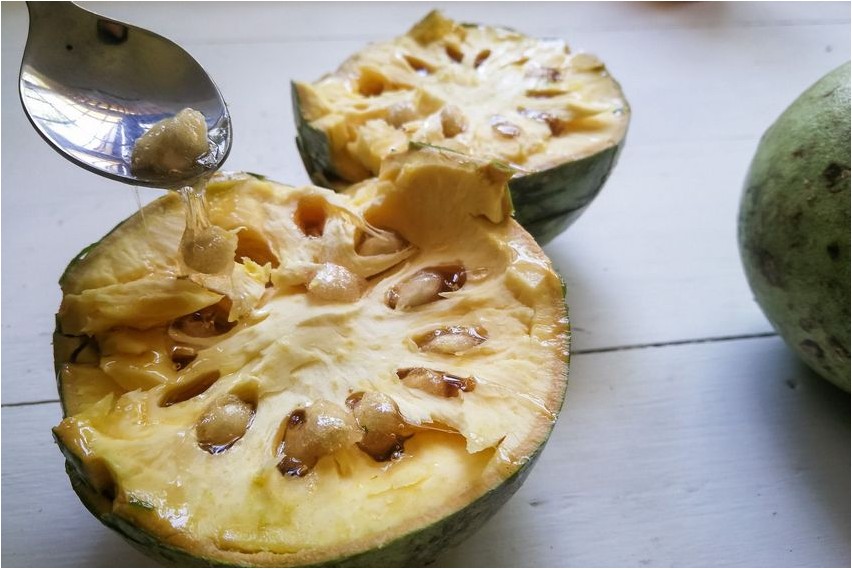
The wood apple (Feronia limonia) is a spectacular fruit tree belonging to the extensive Rutaceae family.
Description
The wood apple is a slow-growing, very upright fruit tree with rather wrinkled bark. Its dark green leaves range from five to twelve and a half centimeters in length, and when rubbed, they emit a rather strong lemon aroma.
The round fruits of the wood apple have a very interesting feature: a very strong and hard woody shell. The diameter of the fruits also varies from five to twelve and a half centimeters, and inside them lies a brown, starchy, and rather sticky pulp. It boasts a slightly astringent, sweet taste and a very pleasant aroma. Within the pulp, you can easily find numerous tiny white seeds. It”s worth noting that the taste of these fruits is completely unlike apples; rather, it”s reminiscent of pineapple or mango.
Where it grows
The wood apple originated in India and Sri Lanka, where it has long been cultivated, growing not only in gardens but also along roadsides. In recent years, this fruit has become quite popular in several Southeast Asian countries, particularly the Philippines and Malaysia.
Uses
The aromatic wood apple”s flesh is most often eaten fresh, although to extract it, one must break the fruit”s rather hard and durable shell. This isn”t easy, so it”s best to have a hard object ready.
The fruit”s pulp is often mixed with sugar, fresh coconut milk, and sweet palm syrup, creating an incredibly delicious sherbet-like treat. It”s also often used in the production of preserves, various confectionery products, jams, drinks, jellies, and chutneys. Sri Lankans make an incomparable custard from these unusual fruits, while Indonesians combine the pulp of ripened fruits with sugar and often indulge in this mixture for breakfast. The Thais haven”t been left out either, adding the young greens to salads.

This fruit is very rich in all kinds of mineral elements and vitamins, however, it still contains less ascorbic acid than all other representatives of the Rutaceae family. In addition, the pulp of the fruit contains citric and some other organic acids, as well as a certain amount of mucus.
In their historical homeland, these fruits have been used since ancient times to improve memory, as well as to treat various cardiovascular ailments and digestive problems. Ripe fruits, which have a powerful tonic and astringent effect, are used to treat gastric diseases. And unripe fruits boast an even stronger astringent effect, which makes them an ideal medicine for dysentery or diarrhea. The leaves of the plant are also suitable for this purpose; in addition, they are excellent for helping with hiccups, as well as stomach upsets and vomiting. And the juice from the fruit is an excellent remedy for the treatment of infectious diseases of the throat and oral cavity (sore throat, gingivitis, stomatitis, etc.). The seeds have also found their application in the treatment of all kinds of heart ailments.
Gum used in painting and medicine is extracted from the branches and trunks of trees, and excellent dyes for silk and chintz are obtained from the peel of the fruit. By the way, the wood of this plant boasts amazing resistance to rotting, which means it makes an excellent building material. And the pulp of the fruit has been successfully used for several centuries as a household detergent and soap.
Contraindications
No contraindications to the use of wooden apple have been identified at the moment, however, the possibility of individual intolerance and allergic reactions cannot be ruled out.
Growing and care
The wood apple will grow best in a tropical or subtropical climate. In general, it is very unpretentious, but at the same time this plant is quite light-loving and intolerant of frost.





