Alfalfa hop-like
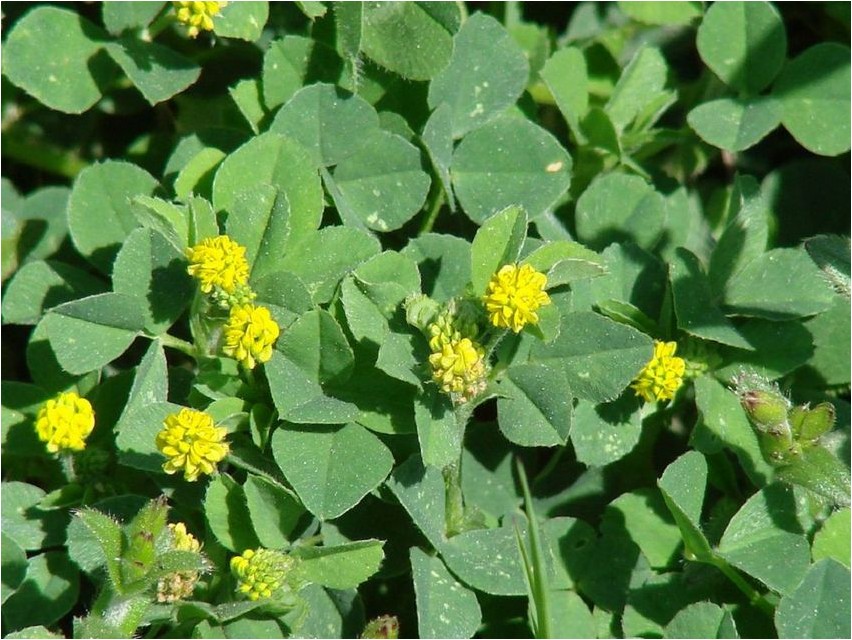
Hoppy alfalfa is one of the plants of the family called legumes; in Latin the name of this plant will be as follows: Medicago lupulina L.
As for the name of the alfalfa family itself, in Latin it will be like this: Fabaceae Lindl. (Leguminosae Juss.).
Description of alfalfa
Hoppy alfalfa is an annual or biennial herbaceous plant, endowed with a taproot that will penetrate the soil to a depth of forty centimeters. It is noteworthy that there are forms that can develop even over three years. The stems of this plant will be ascending or may be spread across the soil, their length will vary between ten and fifty centimeters, such stems are densely leafy and branched. The leaves of alfalfa are endowed with a short petiole and are trifoliate. The leaves of this plant can be either almost rhombic or obovate; they are endowed with a wedge-shaped base and a notch, which is located at the very top. The inflorescences of alfalfa will be capitate and dense, as well as oblong-ovate, they will emerge from the axils of the leaves. The flowers of alfalfa are quite small in size, they are endowed with a yellow corolla, the length of which is about one to three millimeters. The fruit of this plant is a kidney-shaped bean, its length is two to three millimeters, and its diameter is one millimeter. When ripe, such a fruit will be almost black in color, while the seeds are brown or yellow.
The flowering of this plant will last throughout the summer. Under natural conditions, this plant is found in all regions of Russia, Ukraine, the Caucasus, Belarus, and Central Asia. To grow, this plant prefers meadow steppes, places among shrubs, meadows, and as a weed this plant can be found in fields. It is noteworthy that in the mountains, alfalfa can rise to a height of two and a half thousand meters above sea level.
Description of the medicinal properties of alfalfa
Hoppy alfalfa is endowed with very valuable healing properties, and it is recommended to use the herb of this plant for medicinal purposes. It is recommended to harvest such raw materials throughout the entire flowering period of this plant.
The presence of such valuable healing properties should be explained by the content of saponins, tannins, estrogenic substances and calcium salts in the composition of the aerial part of alfalfa. The leaves of this plant contain carotene, vitamin D and ascorbic acid.

The herb of this plant is used in Tibetan medicine and Transbaikalia medicine as an emollient, wound-healing and hemostatic agent. It is recommended to sprinkle the dry herb powder of this plant on cuts and bleeding wounds.
As for traditional medicine in Belarus, a decoction based on this plant is quite widespread here. This decoction of alfalfa is used for douching for trichomonas colpitis. The herb extract of this plant is endowed with a very effective hemostatic effect and will accelerate blood clotting due to the fact that there will be an increase in the content of prothrombin in it.
In the Caucasus, dried alfalfa grass, crushed into powder, is used: this product is used as a wound-healing and hemostatic agent, especially for cuts. It should be noted that this remedy is very effective when used correctly.





