perennial flax
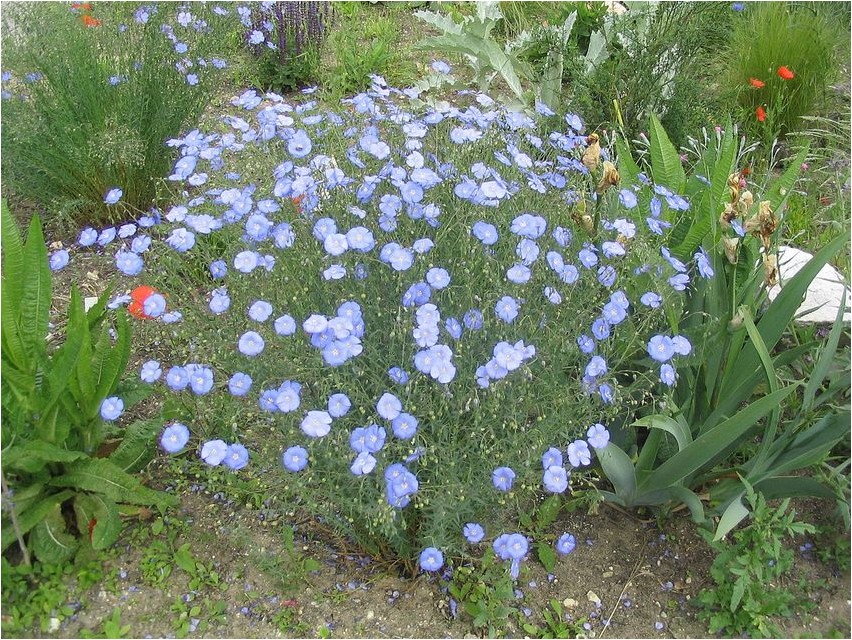
Perennial flax is one of the plants of the family called Flaxaceae; in Latin the name of this plant will be as follows: Linum perenne (L.) (L. altaicum Ledeb. ex Jus., L. sibiricum DC.).
As for the name of the perennial flax family itself, in Latin it will be: Linaceae S. F. Gray.
Description of perennial flax
Perennial flax is a perennial herbaceous plant whose height will vary between fifteen and one hundred centimeters. The root of this plant is vertical and quite powerful, and it is colored in light yellow tones. The flowering stems of perennial flax will be firm and erect, and their color is pale green. The inflorescence of this plant is composed of multi-flowered curls, and the flowers will be relatively small in size, and their diameter will be about two to three centimeters. The sepals of perennial flax will be bluish-pale green, the length of the petals is one to two centimeters, the width is no more than one and a half centimeters. Such sepals can occasionally be white, but most often they are light blue and have a yellowish marigold. The length of the capsule of this plant is five to seven millimeters, and the width is four to six millimeters and is broadly ovoid. The length of the seeds will be about four and a half millimeters, they will be ovoid and flat, and dark brown in color.
Perennial flax blooms from June to July. Under natural conditions, this plant is found in the European Arctic, the Lower Volga, Black Sea, Lower Don, Volga-Kama, Volga-Don and Zavolzhsky regions of the European part of Russia. In addition, this plant is found in the Altai, Irtysh and Verkhnetobolsky regions of Western Siberia, Daursky, Angara-Sayan, Yenisei and Leno-Kolyma regions of Eastern Siberia. For growth, this plant prefers steppe meadow slopes, saline meadows, steppes, forest edges, forest glades, shrubs, sandy river banks, dry stream beds, chalk and limestone outcrops, foothills, sand and plains.
Description of the medicinal properties of perennial flax
Perennial flax is endowed with very valuable healing properties, and it is recommended to use the seeds and grass of this plant for medicinal purposes. The concept of grass includes the leaves, stems and flowers of this plant. The presence of such valuable healing properties should be explained by the content of essential oil in this plant, while the herb contains alkaloids and the cinogenic compound linamiran. The leaves of perennial flax contain flavonoids and vitamin C, while the seeds of this plant contain fatty oil.
As for Tibetan medicine, an infusion prepared from the herbs and seeds of this plant is quite widely used. This healing agent is used as an expectorant, and is also used for oliguria and neurasthenia. In Chinese medicine, a decoction or infusion of perennial flax seeds is used for diarrhea, dysmenorrhea, gonorrhea, and is also used as an anti-inflammatory, emollient and enveloping agent. Externally, this healing agent is used as powder crushed into cake for poultices.

It should be noted that perennial flax is a very valuable honey plant and perganic plant, and in addition to this, it is also an ornamental plant. Moreover, the upper part of this plant will be poisonous to farm animals. Perennial flax can also be cultivated as a fibrous plant.





