Washingtonia
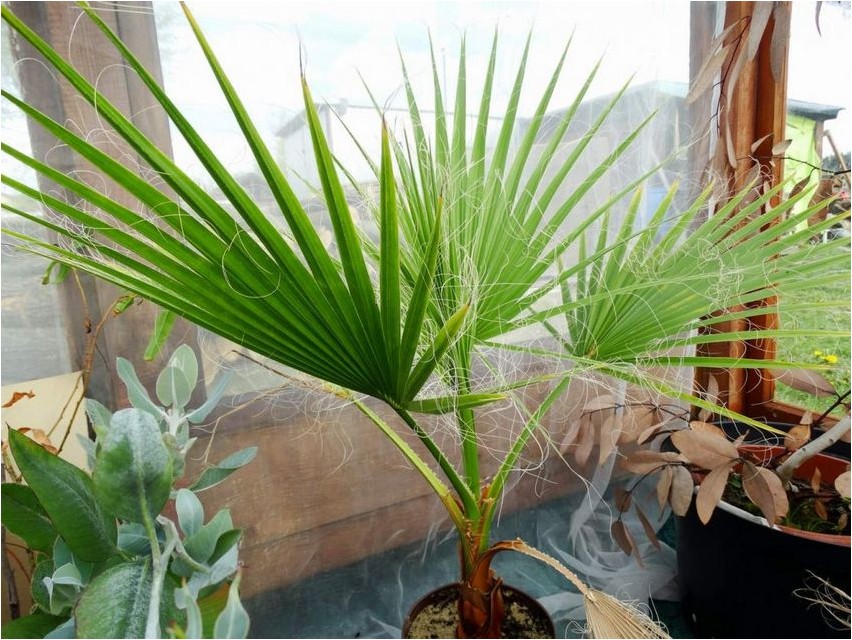
Washingtonia (Latin: Washingtonia) is a woody plant in the Palm family. It is native to western Arizona, southern California, and western Mexico. It is named after US President George Washington.
Cultural Characteristics
Washingtonia is a fast-growing palm. In the wild, it reaches a height of 25-30 m. The trunk is straight and rough, covered in drooping leaves in the upper part, which remain on the trunk for a long time, forming a dense “blanket.” The lower part of the trunk is smooth, with transverse scars. The leaves are very large, linearly dissected, forming a dense crown, divided into segments with numerous twisting filaments between them.
The petioles are short, glabrous, gray-green or brownish, and have strong, inverted spines along the edges. The flowers are bisexual, collected in inflorescences-spadixes, which are wrapped in drooping bracts. The spherical, fleshy fruits are located on the inflorescence axis. Indoors, Washingtonia blooms extremely rarely, usually 12-15 years after planting.
Care
Washingtonia is a sun-loving plant, especially when young. It requires maximum light, with diffused shade from direct sunlight. It is advisable to place Washingtonia on west- and east-facing windows. Periodically, the plant should be rotated, as it stretches toward the light; this will ensure uniform crown development. If sunlight is insufficient, artificial lighting is recommended.

In summer, Washingtonia should be moved outdoors, but protected from strong winds and precipitation. The plant does not tolerate stagnant air. The optimal temperature is 20-25°C (68-77°F) in summer and 10-12°C (50-55°F) in winter. At elevated temperatures and dry air during the dormant period, plants begin to shed their leaves. In rooms with low humidity, plants require regular misting with water or wiping with a damp, soft cloth.
Care
Washingtonia needs systematic and abundant watering. Mature plants can easily tolerate short droughts. For irrigation, use warm water that has been standing for 12 hours. In winter, watering is reduced. Washingtonia should not be over-watered; excessive watering and stagnation of water lead to rotting of the roots, as a result of which the plant may die. The culture has a positive attitude towards fertilizing with complex mineral fertilizers. Fertilizers are applied once every two weeks from March to October. It is not recommended to feed plants in winter.
Reproduction and transplantation
Washingtonia does not produce side shoots, so the crop is propagated only by seeds. Sowing of seeds is carried out in containers filled with a mixture consisting of steamed sawdust, sand and moss in a ratio (1: 1: 1). Charcoal is often added to the substrate. Before sowing, the seeds are treated with sandpaper and soaked in warm water for 24 hours. The seeding depth is 1 cm. The crops are watered and covered with plastic film or glass. The optimal temperature for seed germination is 28C. Fresh seeds of the crop germinate in about 14-20 days.
Seedlings dive after the appearance of the first true leaf. The seedlings are transplanted into pots filled with a substrate, which is made up of light leaf and turf soil, humus and sand (2: 1: 1. 2). In no case should seeds be cut off from seedlings, since they supply young plants with nutrients. One-year-old Washingtonias usually form 4-5 true leaves. Dissection of the leaf blade begins from the eighth leaf.
Washingtonia transplantation is carried out in March-April. Transplantation is carried out as needed after 2-3 years. Plants 7-14 years old every 4 years, plants over 15 years old – every 5 years. The culture has a negative attitude towards transplantation, it suffers for a long time and recovers slowly. Therefore, replanting should be carried out if the soil has become unusable or the roots of Washingtonia have taken up all the free space in the pot.