Ural licorice
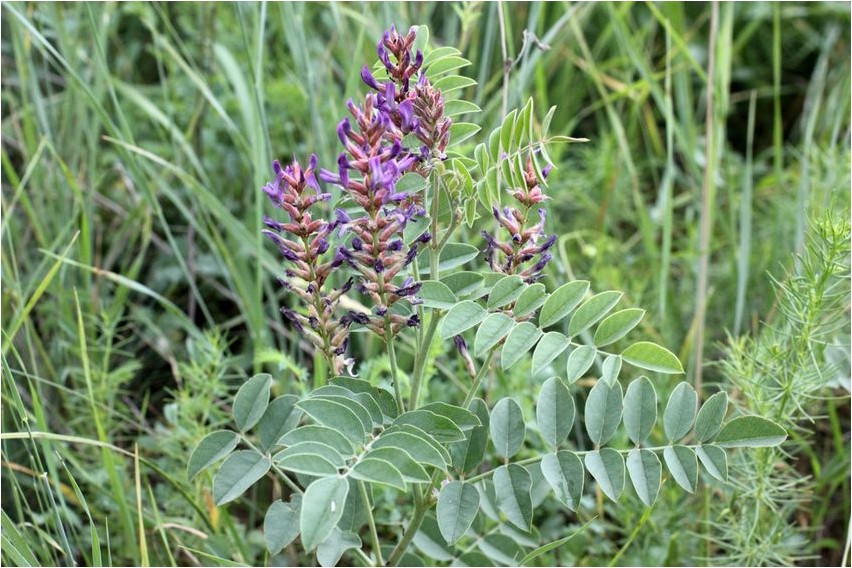
Ural licorice is one of the plants of the family called legumes; in Latin the name of this plant will be as follows: Glycyrrhiza uralense Fisch.
As for the name of the Ural licorice family itself, in Latin it will be: Fabaceae Lrndl. (Leguminosae Juss.).
Description of Ural licorice
Ural licorice is a perennial herbaceous rhizomatous plant, the height of which can even exceed one meter. The root system of this plant will consist of a fairly short rhizome and a vertical woody root, which in turn will reach groundwater. The height of the Ural licorice stems will vary between forty and eighty centimeters; such stems are strong, erect, bristly-rough and unbranched, they will be endowed with glandular spines or small dotted glands. The leaves of this plant are compound, odd-pinnate, alternate, they are endowed with five to seven pairs of ovoid, sticky and glandular-hairy leaves. The corolla of Ural licorice is painted in whitish-violet tones and is endowed with an elliptical flag. There are only ten stamens of this plant, and nine of them will be fused together. The fruit of Ural licorice is a transversely sinuous, multi-seeded, sickle-shaped, linear-oblong bean. The length of such a bob will be about two to four centimeters, while the width will be five to eight millimeters. The seeds of this plant are brownish in color, smooth and rounded kidney-shaped.
Flowering of Ural licorice occurs from June to July, while fruit ripening occurs from August to September. Under natural conditions, this plant grows in Kyrgyzstan, the south of the European part of Russia, the Caucasus, Kazakhstan, Central Asia and the south of Western Siberia. For growth, Ural licorice prefers thickets of shrubs, floodplains, steppe and meadow areas, beds of drying rivers, banks of irrigation canals and reservoirs, oxbow lakes, as well as depressions and small depressions.
Description of the medicinal properties of Ural licorice
Ural licorice possesses valuable medicinal properties, and its roots and rhizomes are recommended for medicinal purposes. These valuable medicinal properties are attributed to the pectin, sucrose, starch, glucose, tannins, flavonoids, nitrogen-containing compounds, and the following organic acids: malic, succinic, tartaric, citric, oxalic, and fumaric.
In scientific medicine, preparations based on Ural licorice are used as expectorants and emollients for various respiratory ailments, as well as for hemorrhoids and chronic constipation. Furthermore, these medications are indicated for use as a gentle laxative and for regulating water-salt balance. In powdered form, the root of this plant is included in various laxatives, chest, hemorrhoid, and stomach teas. Ural licorice-based preparations are low-toxic and possess antispasmodic, antidote, antihistamine, anti-inflammatory, antiallergic, diuretic, and anticholinergic properties. Ural licorice extracts, in turn, exhibit highly effective antifibrinolytic and anticoagulant properties.

Naked licorice, or licorice – medicinal benefits / Zakhar Travnik





