Zheleznitsa mountain
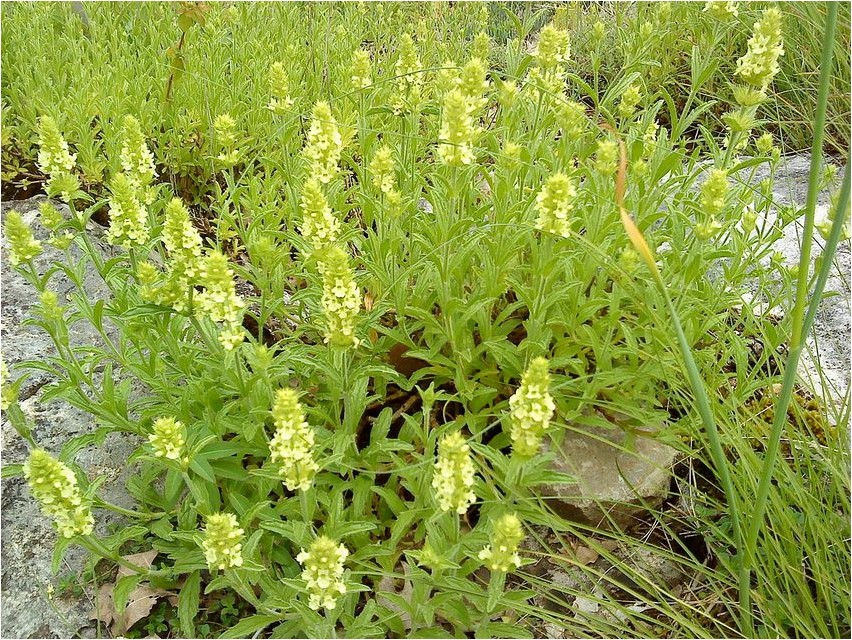
The mountain ironweed is one of the plants of the family called Lamiaceae; in Latin the name of this plant will be as follows: Sideritis montana L.
As for the name of the mountain iron family itself, in Latin it will be like this: Lamiaceae Lindl.
Description of the mountain railway
Mountain ironweed is an annual herbaceous plant, the stem of which is erect; it can be either branched from the base or simple. Such a stem will be covered with protruding hairs. The leaves of this plant are short-petiolate and oblanceolate. The flowers are located in spread out false whorls and in the axils of the bracts, which will be similar to the stem leaves. It is noteworthy that the uppermost leaves are without flowers in the axils. The corolla will be shorter than the calyx itself, it is painted in light yellow tones. The bend of this corolla is located closer to the edge; it is colored in red-brown tones. After drying, the corolla will become dark brown in color. The corolla is also equipped with a tube enclosed in cups, the length of which is three millimeters. Also, the upper lip will be slightly convex and its length will be one and a half millimeters, and the lower lip will not exceed one millimeter in length.
Mountain ironweed blooms from June to September. Under natural conditions, the plant is found in Moldova, the Caucasus, Central Asia, as well as in the Dnieper region, the Carpathians and southern Ukraine. This plant can also be found in the following areas of the European part of Russia: the Volga region, the Far East and the Black Sea region. For growth, the plant prefers rocks, rocky and sandy slopes, steppes, meadows and fallow lands. The plant is a weed and is found up to the mid-mountain zone. This plant is a honey plant and is also poisonous to horses.
Description of the medicinal properties of mountain ironweed
Mountain ironweed is endowed with quite valuable healing properties, and it is recommended to use the herb of this plant for medicinal purposes. The term grass includes leaves, stems and flowers.
The presence of such valuable healing properties is explained by the content of iridoids, essential oil, as well as phenolcarboxylic acids and their derivatives in the plant. The plant is capable of having antitumor effects, and is also endowed with repellent properties and can exhibit antibacterial activity.

The essential oil of this plant can be used in the perfumery and cosmetics industry, which is due to the fact that the plants are endowed with antiprotozoal and antibacterial activity. The entire aerial part of the mountain ironweed can be used as a spice, but the leaves of this plant can be used as a tea substitute.
For cancer diseases, in complex treatment, it is recommended to use the following remedy based on mountain ironweed: to prepare such a remedy, you will need to take three tablespoons of dry crushed herbs of this plant per half liter of boiling water. The resulting mixture should be infused for two hours, and then this mixture is filtered very carefully. Take this remedy one-third or one-fourth of a glass three times a day.
For bronchitis, acute respiratory diseases and pneumonia, you should use the following remedy based on mountain ironweed: to prepare this remedy, take two tablespoons of a mixture of this plant, coltsfoot leaves, yarrow herb and string herb in four hundred milliliters of boiling water. The resulting mixture is infused for two hours and then carefully filtered. Take this remedy one third of a glass three to four times a day.





